
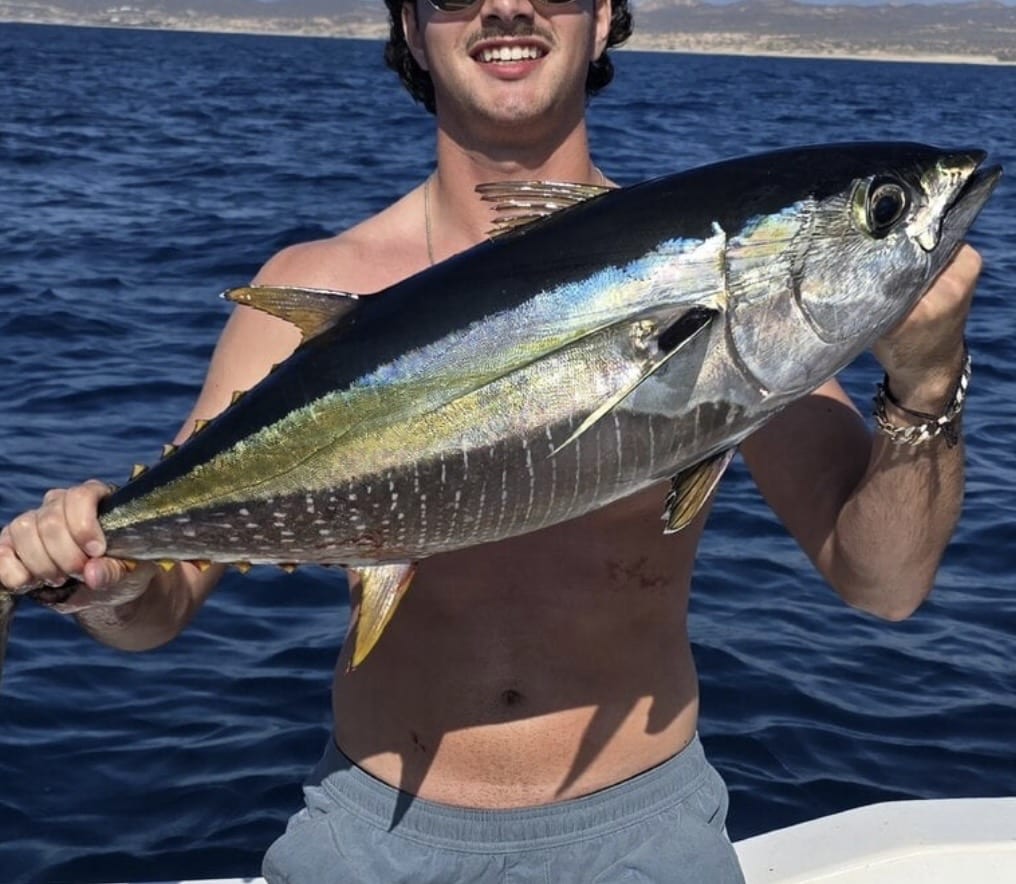
Yellowfin Tuna
The Cabo San Lucas Guide
The last three IGFA all tackle world records for yellowfin tuna were all caught in Mexican waters of Baja California. Mike Livingston's 405 pound fish at Magdalena Bay in 2010. Guy Yocom's 427 pound million dollar tuna off Cabo in 2012. Earl Gill IV's current 443 pound record from the Lower Banks of Mexico in 2024. No other region on Earth has produced this trinity of records in the modern era of sportfishing. This is the encyclopedia for the fishery that defines the species.
Why Mexico Holds the Cow Tuna Crown
In sportfishing, a yellowfin tuna weighing over 200 pounds is called a "cow." A yellowfin over 300 pounds is a "super cow." A yellowfin over 400 pounds is in legendary company, with only four ever documented on rod and reel under IGFA rules. Three of those four 400+ pound legends were caught in Baja waters within a 15 year window.
Three Consecutive World Records, All From Mexico
The last three IGFA all tackle world records for yellowfin tuna were all caught in Baja California waters. No other region on Earth holds this distinction. The geography, the seamount structure, and the convergence of the Pacific Ocean with the Sea of Cortez have made these waters the documented capital of trophy yellowfin fishing.
405 lb
Mike Livingston
Magdalena Bay 2010427 lb
Guy Yocom
Cabo San Lucas 2012443 lb
Earl Gill IV
Lower Banks 2024What earns Cabo the title
- The seamount factory. Gordo Banks, the Lower Banks, and adjacent structure produce documented super cows nearly every season. Multiple fish over 300 pounds appear in Cabo catch reports each November and December.
- Year round availability. Yellowfin tuna are present in Cabo waters every month of the year. The 200+ pound cows arrive in late summer and stay through early winter.
- The Sea of Cortez convergence. The warm waters of the Sea of Cortez meet the cooler Pacific exactly where Cabo sits. The temperature breaks created by this convergence concentrate bait and tuna in predictable patterns.
- Deep water proximity. The 1,000 fathom curve sits within 5 miles of the Cabo arch. Productive cow tuna waters begin almost immediately upon leaving the marina.
- Tournament infrastructure. The Los Cabos Tuna Jackpot is one of the most respected tuna specific tournaments in the Pacific, drawing teams from across the United States and Mexico annually.
- Legendary boats. El Suertudo, the 61 foot Viking that landed Yocom's 427 pound record, remains based in Cabo. Long range vessels like the Excel run trips that target the Lower Banks specifically for record class fish.
Thunnus albacares: The Apex Pelagic
The yellowfin tuna (Thunnus albacares) is a member of the family Scombridae, the same family that includes mackerels, bonitos, and the other tuna species. First described by Bonnaterre in 1788, the species is one of the most economically valuable fish in the world and one of the most coveted gamefish for trophy anglers.
Scientific maximum 239 cm fork length. Cow tuna in Cabo measure 6 to 7 feet.
Current all tackle record (Earl Gill IV, Mexico, November 2024).
Among the fastest fish in the ocean, capable of 80 km per hour sprints.
Average lifespan 8 years, maximum reported age 18 years.
Names across cultures
- English: Yellowfin tuna, allison tuna, yellowfinned albacore, yellow-fin tunny
- Hawaiian: Ahi (shared with bigeye tuna)
- Spanish (Mexico): Atún aleta amarilla, rabil
- Japanese: Kihada (yellow skin)
- French: Albacore à nageoires jaunes
Taxonomic classification
| Rank | Classification |
|---|---|
| Kingdom | Animalia |
| Phylum | Chordata |
| Class | Actinopterygii (ray finned fishes) |
| Order | Scombriformes |
| Family | Scombridae (mackerels, tunas, bonitos) |
| Subfamily | Scombrinae |
| Genus | Thunnus |
| Species | T. albacares |
| Authority | Bonnaterre, 1788 |
Distribution and range
Yellowfin tuna are found worldwide in tropical and subtropical seas, with the notable exception of the Mediterranean. Their range extends from 50 degrees North latitude to 50 degrees South. The species is classified as highly migratory and individuals routinely cross entire ocean basins. The eastern Pacific population that supplies the Cabo fishery is genetically distinct from but interconnected with the central and western Pacific populations.
The High Performance Pelagic Machine
Yellowfin tuna are biological masterpieces of pelagic predation. From their hydrodynamic shape to their unique regional endothermy, every aspect of their anatomy is engineered for sustained high speed swimming, long range migration, and aggressive ambush predation.
External features
- Body: Fusiform, torpedo shaped, deepest at midpoint then tapering sharply to a slender peduncle
- Coloration: Black to dark metallic blue back, golden yellow lateral band, silver white belly
- Dorsal fin: Bright yellow, very long second dorsal fin and anal fin (the source of the common name)
- Finlets: 8 to 10 yellow finlets on dorsal and ventral surfaces, each edged with black
- Pectoral fins: Moderately long, reaching past the origin of the second dorsal fin in adults
- Caudal fin: Lunate, sharply forked for maximum thrust efficiency
Regional endothermy: warm blooded tuna
Unlike most fish, yellowfin tuna can maintain certain body tissues at temperatures significantly above ambient water temperature. This adaptation, called regional endothermy, supports the metabolism required for sustained high speed swimming. Specialized vascular structures called rete mirabile act as biological counter current heat exchangers, conserving heat generated by swimming muscles. The result is a fish that can hunt effectively in waters from 15 to 31 degrees Celsius and accelerate explosively when prey is detected.
Internal adaptations for speed
- Dense red muscle tissue dominates the body, supporting aerobic metabolism for sustained swimming
- Specialized circulatory system maintains warm core temperature during cold water dives
- High heart rate and stroke volume deliver oxygen to working muscles at high speed
- Streamlined retractable fins reduce drag during burst sprints
- Bony external scutes on the caudal peduncle provide rigidity for tail thrust
Speed and swimming performance
Yellowfin tuna are documented at burst speeds approaching 80 kilometers per hour (50 mph), placing them among the fastest fish in the ocean alongside wahoo, marlin, and sailfish. Cruising speeds are sustained at 5 to 8 mph during long migrations. The species depth range extends from the surface to 1,602 meters according to FishBase records, though they typically hunt and rest in the upper 250 meters of the water column.
The Modern Trinity of World Records
The story of the IGFA all tackle yellowfin tuna world record is essentially a story of Baja California sportfishing. A previous record that stood for 33 years was broken in 2010 at Magdalena Bay, broken again in 2012 off Cabo San Lucas, and broken once more in 2024 at the Lower Banks of Mexico. Each catch added context to what makes these waters unique.
Record progression by Baja California fish
| Year | Weight | Angler | Location | Vessel |
|---|---|---|---|---|
| 1977 | 388 lb 12 oz | Curt Wiesenhutter | San Benedicto Island, Mexico | Royal Polaris |
| 2010 | 405 lb | Mike Livingston | Magdalena Bay, Mexico | Vagabond |
| 2012 | 427 lb | Guy Yocom | 180 mi south of Cabo, Mexico | El Suertudo |
| 2024 | 443 lb | Earl Gill IV | Lower Banks, Mexico | Excel |
Timeline of yellowfin tuna world records
The 33 Year Record
Curt Wiesenhutter lands a 388 lb 12 oz yellowfin tuna at San Benedicto Island, Mexico aboard the Royal Polaris. The record stands unchallenged for over three decades, becoming one of the longest standing IGFA all tackle records of the era.
Livingston Breaks the Drought
Mike Livingston lands a 405 pound yellowfin tuna at Magdalena Bay, Mexico aboard the San Diego based long range vessel Vagabond. The catch breaks the 33 year record and confirms that exceptional yellowfin still exist in Baja waters.
The Pedigo Disqualification
Robert Pedigo lands a 427.9 pound yellowfin off Puerto Vallarta aboard the Journeyman. The fish would have set a new world record, but the catch is disqualified by IGFA because deckhand Danny Osuna touched the rod during the fight. The Livingston record stands.
The Million Dollar Tuna
Guy Yocom lands a 427 pound yellowfin tuna 180 miles south of Cabo San Lucas aboard El Suertudo with Captain Greg DiStefano. The catch breaks Livingston's record by 22 pounds and wins Yocom the $1 million Mustad Hook A Million contest, the largest angler side payout in sportfishing history.
The 443 Pound Super Cow
Earl Gill IV lands a 443 pound yellowfin aboard the Excel long range vessel at the Lower Banks off Mexico, captained by Justin Fleck. The 1 hour and 45 minute fight produces only the fourth yellowfin over 400 pounds ever documented on rod and reel under IGFA rules.
IGFA Certification
The IGFA officially certifies Gill's catch as the new All Tackle World Record and the Men's 60 kilogram (130 pound) Line Class Record, surpassing the previous benchmarks by 16 pounds. The record was certified five months after the catch following standard IGFA review.
The Gordo Banks super cow factory
Beyond the all tackle records, Gordo Banks off San Jose del Cabo has produced a steady stream of super cows. Documented catches include a 310 pound yellowfin on November 9 just after the Los Cabos Tuna Jackpot tournament, a 370 pound fish landed November 12 aboard the vessel Hard Efforts after a 60 minute fight on live skipjack bait, and a 365 pound tuna weighed at La Playita, the local marina with closest access to Gordo Banks. All three super cows were caught within a three week window during a single season.
The Million Dollar Tuna: Guy Yocom's 427 Pound Catch
On September 18, 2012, one of the most calculated and rewarded catches in sportfishing history played out off the coast of Cabo San Lucas. The story combines a custom built sportfisher, a million dollar promotion, and the kind of preparation that turns luck into legend.
El Suertudo: The Lucky One
Guy Yocom of Dana Point, California specifically targeted a world record yellowfin tuna to enter the Mustad Hook A Million contest. Mustad had promised $1 million USD to any angler who set an IGFA all tackle world record while using a Mustad hook. Yocom equipped his 61 foot Viking sportfisher El Suertudo (Spanish for "The Lucky One") with the captain Greg DiStefano and crew, set up tackle to IGFA specifications, and ran 100 miles south of Cabo to drift over deep water.
At approximately 10:45 AM, with the boat drifting chunk bait, a behemoth tuna inhaled a submerged bait. The fight lasted approximately 50 minutes. The crew sank IGFA approved gaffs into the 7.5 foot long fish and brought it aboard. The official certified weight was 427 pounds, beating Mike Livingston's 405 pound record by 22 pounds. Tracy Ehrenberg of Pisces Sportfishing in Cabo San Lucas broke the news to the sportfishing press as the El Suertudo pulled into harbor.
Yocom received the $1 million prize from Mustad at the Fred Hall Show in Long Beach the following year. The prize was paid in $20,000 annual installments over 50 years. The catch remains the most financially significant single yellowfin tuna in the history of sportfishing.
The tackle setup that worked
- Reel: Shimano Tiagra (full strike drag)
- Rod: Melton Tackle stand up rod
- Hook: Mustad 12/0 Demon Perfect Circle Hook 39950BLN (the qualifying hook for the contest)
- Main line: 100 pound test Jerry Brown Line One Hollow Core Spectra
- Leader: Yo-Zuri 200 pound fluorocarbon
- Belt: Black Magic fighting belt
- Bait: Cut chunk bait drifted at depth
The legacy continues
El Suertudo remains based in Cabo to this day, still captained by Greg DiStefano. The boat has continued producing tournament wins and trophy fish across multiple species. In 2025, Greg's son Micah Stefano landed a 762.5 pound black marlin aboard El Suertudo, extending the boat's legendary status in Cabo waters.
The Geography of Cow Tuna Country
The reason Cabo and Baja California produce trophy yellowfin tuna at this scale is geographic. Multiple seamount systems rise within reach of the coast, the continental shelf drops to abyssal depths almost immediately, and the convergence of two ocean systems creates a permanent zone of productivity that concentrates baitfish and the predators that hunt them.
The major yellowfin grounds
- Gordo Banks. 8 to 10 miles off Puerto Los Cabos Marina in San Jose del Cabo. The seamount rises from over 3,000 feet to within 150 feet of the surface. Produces both cows and super cows during peak season, with documented multi season catches over 300 pounds.
- The Lower Banks. A series of offshore banks several hundred miles south of Cabo. Accessed primarily by long range vessels from San Diego on 7 to 14 day trips. The current IGFA world record was set here in 2024.
- San Jaime Bank. South of Cabo San Lucas in deeper water. Productive during summer and fall blue water months.
- Iman Bank. Further offshore from San Jose del Cabo. Shares water with wahoo grounds during overlapping seasons.
- 1150 Spot. 20 miles offshore from Cabo. Productive seamount during summer through fall.
- Cabrillo Seamount. 28 miles north of Cabo. Off the beaten path but produces trophy class fish.
- San Benedicto Island. Part of the Revillagigedo Archipelago, accessed by long range vessels. The 1977 record (388 lb 12 oz) was set here.
- Magdalena Bay. Northwest of Cabo on the Pacific coast of Baja California Sur. Site of Mike Livingston's 405 pound 2010 record.
The two ocean convergence
Cabo sits at the southern terminus of the Baja California peninsula, where the cooler Pacific Ocean to the west meets the warmer Sea of Cortez to the east. Temperature breaks created by this convergence shift seasonally and create predictable patterns of bait concentration. Cow tuna follow these patterns, which is why local captains can target specific zones based on time of year and recent water temperature readings.
Submarine geography
The continental shelf off Cabo drops to abyssal depths within 5 miles of shore. The 1,000 fathom curve (6,000 feet of depth) sits closer to the marina here than at any other major sportfishing destination on the planet. The combination of deep water proximity and submarine structure means productive tuna water is a short run from the dock.
Yellowfin Season and The Cow Window
Yellowfin tuna are available in Cabo waters year round, but size and density change dramatically with the calendar. Understanding which window produces which class of fish is essential for planning a serious tuna trip.
Month by month
| Month | Activity | Notes |
|---|---|---|
| January to April | Background | Schoolie yellowfin (15 to 50 lb) caught regularly, larger fish rare |
| May to June | Building | Average size growing, first 80 to 120 lb fish appear |
| July | Solid | Productive bite establishing, fish 50 to 150 lb common |
| August | Peak begins | First cow tuna of the season appear, fish over 200 lb landed |
| September | Peak | Yocom's 427 lb record was caught in September. Super cows possible. |
| October | Tournament peak | Los Cabos Tuna Jackpot. Cows and super cows consistently produced. |
| November | Late peak | Documented Gordo Banks 310 lb, 365 lb, 370 lb super cows. Earl Gill record was November. |
| December | Tapering | Bite still present, cooler water beginning to shift the fishery |
The cow window: August through November
The four month window from August through November is when trophy yellowfin appear in Cabo waters. The Los Cabos Tuna Jackpot tournament is timed for early November to coincide with this window. The current and previous IGFA all tackle world records were both set in this window (September 2012, November 2024). If a trophy tuna is the trip goal, plan accordingly.
Conditions that produce trophy fish
- Surface water temperatures 75 to 82 F at Gordo Banks and offshore zones
- Active porpoise pods on the surface, often a signal of large tuna underneath
- Bait concentrations of skipjack, sardines, or mackerel on the bank structure
- Stable barometric pressure, large fish feed most aggressively in steady weather
- Dawn and dusk windows, low light feeding most productive for the biggest fish
Chunking, Live Bait, and Heavy Tackle
The techniques used to catch trophy yellowfin tuna in Cabo are specialized. Both the current world record (Earl Gill IV) and the previous world record (Guy Yocom) were caught while chunking. This is the method of choice for serious cow tuna anglers.
Chunking technique
Chunking is a passive presentation where cut bait pieces are set at depth and allowed to drift naturally with the current. The boat drifts over productive structure, often anchored or with minimal engine input. Trophy yellowfin are attracted by the scent trail and the natural fall of the chunks.
- Cut bait pieces (typically skipjack tuna or mackerel) deployed at depths of 100 to 150 feet
- Multiple lines fished at different depths to cover the water column
- Chum slick maintained throughout the drift to keep tuna interested
- No rod movement, the bait must appear natural to a cautious cow tuna
- Patience required, productive drifts can last 30 minutes to several hours before a bite
Live bait technique
The Gordo Banks super cows of November 2024 were all caught on live skipjack tuna. Live baits are bridled to the hook with waxed line or rubber band and slow trolled or drifted near the structure.
- Live skipjack tuna 3 to 8 pounds is the gold standard for trophy yellowfin
- Live mackerel and live caballitos work for smaller class fish
- Bridle rigging keeps the bait swimming naturally with the hook exposed
- Slow trolling at 1 to 3 knots over productive structure
- Free spooled drift with the engine off in calm conditions
Required tackle for cows
- Reel: 130 lb class two speed lever drag (Shimano Tiagra 130, Penn International 130, Okuma Makaira 130)
- Rod: Heavy stand up trolling rod rated for 80 to 130 lb class line
- Main line: 100 to 130 lb braided Spectra for line capacity
- Top shot: 100 to 200 lb fluorocarbon for invisibility
- Hook: Mustad 39950BLN Demon Perfect Circle or equivalent 12/0 to 14/0 circle hook
- Belt and harness: Stand up belt and bucket harness mandatory for fights that can last hours
What to expect during the fight
A cow yellowfin tuna fight is unlike any other. The first run can strip several hundred yards of line. Yellowfin do not typically jump like marlin but they dive deep and fight in long power runs and slow death circles. Trophy fish over 200 pounds routinely take 45 minutes to over two hours to land. Earl Gill's 443 pound record required 1 hour and 45 minutes. Most anglers underestimate the physical demands of fighting a fish this size.
Ahi: Cuisine of the Yellowfin
Yellowfin tuna is one of the most prized fish in global cuisine. The Hawaiian name "ahi" is now synonymous with premium sushi and sashimi worldwide. The flesh is firm, deep red to pink, mild and clean flavored, and contains relatively low fat compared to bluefin tuna, making it lean and versatile.
Nutritional profile (per 100g raw)
| Nutrient | Amount | Notes |
|---|---|---|
| Calories | ~110 kcal | Lean protein, lower than salmon |
| Protein | ~25 g | Complete amino acid profile, exceptional source |
| Fat | ~1 g | Very low fat, lean meat |
| Omega 3 | ~0.2 g | EPA and DHA, beneficial fatty acids |
| Vitamin B12 | High | Essential for nerve function |
| Mercury | ~0.35 ppm | FDA "Good Choices" category |
Sashimi grading
Commercial yellowfin tuna is graded for sashimi quality based on color, fat content, freshness, and texture. The grades are:
- Grade #1 (Sashimi Grade): Top quality, deep red color, firm texture, high fat content. Used in premium sushi restaurants.
- Grade #2: Good quality, slightly less ideal color or texture. Still excellent for sashimi at most restaurants.
- Grade #2+: Above average. Mix between Grade 1 and Grade 2.
- Grade #3: Cooking grade. Excellent for searing, grilling, or smoking but not raw consumption.
Recommended preparations
- Sashimi: Thin slices, served raw with soy sauce, wasabi, and pickled ginger. The benchmark for premium ahi.
- Sushi: Cubed or sliced on seasoned rice. Maguro nigiri, ahi rolls, and chirashi bowls.
- Poke: Hawaiian style cubed raw tuna with shoyu, sesame oil, scallions, and seaweed.
- Ceviche: Mexican preparation. Lime juice "cooks" the tuna with chiles, onion, and cilantro.
- Seared steaks: Rare to medium rare, hot pan sear, salt and pepper. The flesh dries out quickly if overcooked.
- Tataki: Quick seared exterior with raw interior, sliced thin and served with ponzu.
- Tacos: Mexican coastal style. Seared or raw with cabbage slaw, lime, salsa verde.
Mercury and food safety
Yellowfin tuna is classified by FDA and EPA in the "Good Choices" category, with average mercury content around 0.35 parts per million. Most adults can safely consume one serving per week. Pregnant women, nursing mothers, and young children should reference the FDA "Best Choices" list for lower mercury alternatives. Sashimi grade ahi should be sourced from reputable suppliers and ideally frozen at minus 20 C for at least 7 days to eliminate any parasite risk.
Stock Status and Conservation
Yellowfin tuna are one of the most economically valuable fish on the planet and consequently one of the most heavily fished. The species supports massive commercial operations including purse seiners, longliners, and pole and line fisheries across the global tropics. Sportfishing pressure is comparatively minor but the recreational sector still plays a role in responsible management.
Stock status
| Stock | Status | Notes |
|---|---|---|
| Eastern Pacific (Cabo region) | Healthy | Currently fished at or near maximum sustainable yield |
| Western and Central Pacific | Healthy | Largest population, sustainable harvest levels |
| Atlantic | Overfished | Recovery plans in place under ICCAT |
| Indian Ocean | Overfished | Under management by IOTC |
Mexican regulations
- Mexican law permits keeping up to 5 yellowfin tuna per angler per day under recreational license
- Mexican fishing license required for all anglers, available at the marina ($20 USD)
- Long line fishing for tuna is regulated within Mexican territorial waters
- Tournament catches must comply with IGFA rules including line class, gear, and weighing procedures
Catch and release for trophy class
Many serious tuna anglers in Cabo are now releasing yellowfin under 100 pounds and selectively keeping fish for the table or for tournament weigh ins. This approach allows juvenile tuna to grow into the cow class fish that drive the fishery's reputation. Daliken Sportfishing supports selective harvest and encourages release of smaller fish when guests have already secured their catch.
Sustainable handling for kept fish
- Bleed and ice fish immediately upon landing to preserve quality
- Vacuum sealing and freezing extends shelf life significantly
- Daliken offers free filleting at the marina and optional vacuum packing for $2 USD per pound
- Tournament fish are weighed and donated through partner programs when possible
Glossary of Tuna Fishing Terms
- Ahi
- Hawaiian name for yellowfin tuna, also used for bigeye tuna. Now used commercially worldwide to denote premium sashimi grade tuna.
- Bridled bait
- Rigging technique where the hook is attached to a live baitfish via a bridle of waxed line or rubber band, allowing the fish to swim naturally while keeping the hook exposed.
- Chunking
- Technique of fishing cut bait pieces (chunks) drifted at depth. The method used to land both the current and previous world record yellowfin tuna.
- Cow
- A yellowfin tuna weighing over 200 pounds. The benchmark size for serious trophy anglers.
- El Suertudo
- "The Lucky One" in Spanish. The 61 foot Viking sportfisher owned by Guy Yocom that landed the 427 pound million dollar tuna in 2012. Still based in Cabo.
- FAD
- Fish Aggregating Device. Floating structure used in commercial tuna fishing to concentrate fish. Not used in sportfishing.
- Fork length
- The standard biological measurement of a fish from the tip of the snout to the fork of the tail.
- Gordo Banks
- The seamount system 8 to 10 miles off San Jose del Cabo. Produces super cows nearly every season and is the primary trophy tuna ground accessible by day trip from the marina.
- Grade 1
- The highest sashimi grade for yellowfin tuna, indicating deep red color, firm texture, and high fat content. Used in premium sushi restaurants.
- Hook A Million
- The Mustad Hook Company promotion that paid $1 million USD to the first angler to set an IGFA all tackle world record using a Mustad hook. Won by Guy Yocom in 2012.
- IGFA
- International Game Fish Association. The governing body that certifies sportfishing world records.
- Lower Banks
- A series of offshore banks several hundred miles south of Cabo, accessed by long range vessels. Site of the current 2024 IGFA world record yellowfin tuna.
- Mustad Demon Perfect Circle
- The specific hook model (12/0 39950BLN) used to land the 427 pound world record yellowfin in 2012, qualifying for the Hook A Million prize.
- Pelagic
- Living in the open ocean rather than near the sea floor. Yellowfin tuna are highly pelagic.
- Regional endothermy
- The biological adaptation in tunas that maintains certain body tissues at temperatures above ambient water temperature, supporting high metabolism for sustained speed.
- Rete mirabile
- "Wonderful net" in Latin. The specialized network of blood vessels in tunas that acts as a heat exchanger, conserving body heat. Fundamental to tuna physiology.
- Scombridae
- The biological family that includes yellowfin tuna along with bluefin tuna, bigeye tuna, albacore, mackerel, wahoo, and bonito.
- Stand up tackle
- Rod and reel setup designed for fighting fish without a fighting chair, using a belt and harness. Standard for most Cabo charters and required for many tournament categories.
- Super cow
- A yellowfin tuna weighing over 300 pounds. Exceptionally rare globally but documented multiple times per season at Gordo Banks.
- Tagged fish
- A fish that has been marked with an external or internal identification tag for scientific research, particularly common in pelagic species like tuna and marlin.
Frequently Asked Questions
What is the world record yellowfin tuna?
Why is Cabo San Lucas the yellowfin tuna capital of the world?
What is the Million Dollar Tuna?
What is a cow tuna?
When is yellowfin tuna season in Cabo?
How big do yellowfin tuna get?
How fast can yellowfin tuna swim?
What technique do you use for cow tuna?
What is ahi?
What does a tuna charter cost?
References
- International Game Fish Association. All Tackle World Record Yellowfin Tuna. Earl Gill IV, 443 lb, Lower Banks Mexico, November 11, 2024. Certified April 15, 2025. igfa.org
- IGFA. World Records for April 2025. Official certification announcement of Earl Gill IV's record.
- Sport Fishing Magazine. A New World Record Yellowfin Tuna. November 2024 report on Earl Gill IV catch aboard the Excel.
- Sport Fishing Magazine. Million Dollar Tuna: Confirmed. 2013 report on Guy Yocom's 427 lb catch and the Mustad Hook A Million prize.
- BD Outdoors. The Story Behind the Million Dollar Tuna. Detailed catch account, El Suertudo and Captain Greg DiStefano.
- InTheBite Magazine. A Record Catch in Baja: Yellowfin Tuna World Record. May 2025.
- Melton Tackle. The New Pending IGFA World Record Yellowfin Tuna: The Full Story. Documentation of Earl Gill IV's tackle setup and catch.
- MarineBio.org. Yellowfin Tuna, Thunnus albacares. Species profile and biology.
- FishBase. Thunnus albacares (Bonnaterre, 1788). Taxonomy, morphology, and ecology database. fishbase.se
- NOAA Fisheries. Yellowfin Tuna Species Information. Stock status and management documentation.
- Outdoor Life. Angler Catches Likely World Record Yellowfin Tuna Off the Coast of Southern California. November 2024 reporting on Earl Gill IV's catch.
- USA Today For The Win Outdoors. Giant yellowfin tuna puts anglers at tipping point. Documentation of Gordo Banks super cows November 2024.
- FDA / EPA. Advice About Eating Fish: Good Choices. Mercury classification for yellowfin tuna.
- Daliken Sportfishing. Local fish reports and operational data, San Jose del Cabo, 2025 to 2026.
Fish the Cow Tuna Capital
The waters that produced the last three IGFA world records for yellowfin tuna. Daliken Sportfishing runs private trophy tuna charters from Puerto Los Cabos Marina with direct access to Gordo Banks, the documented super cow factory of the Pacific.