
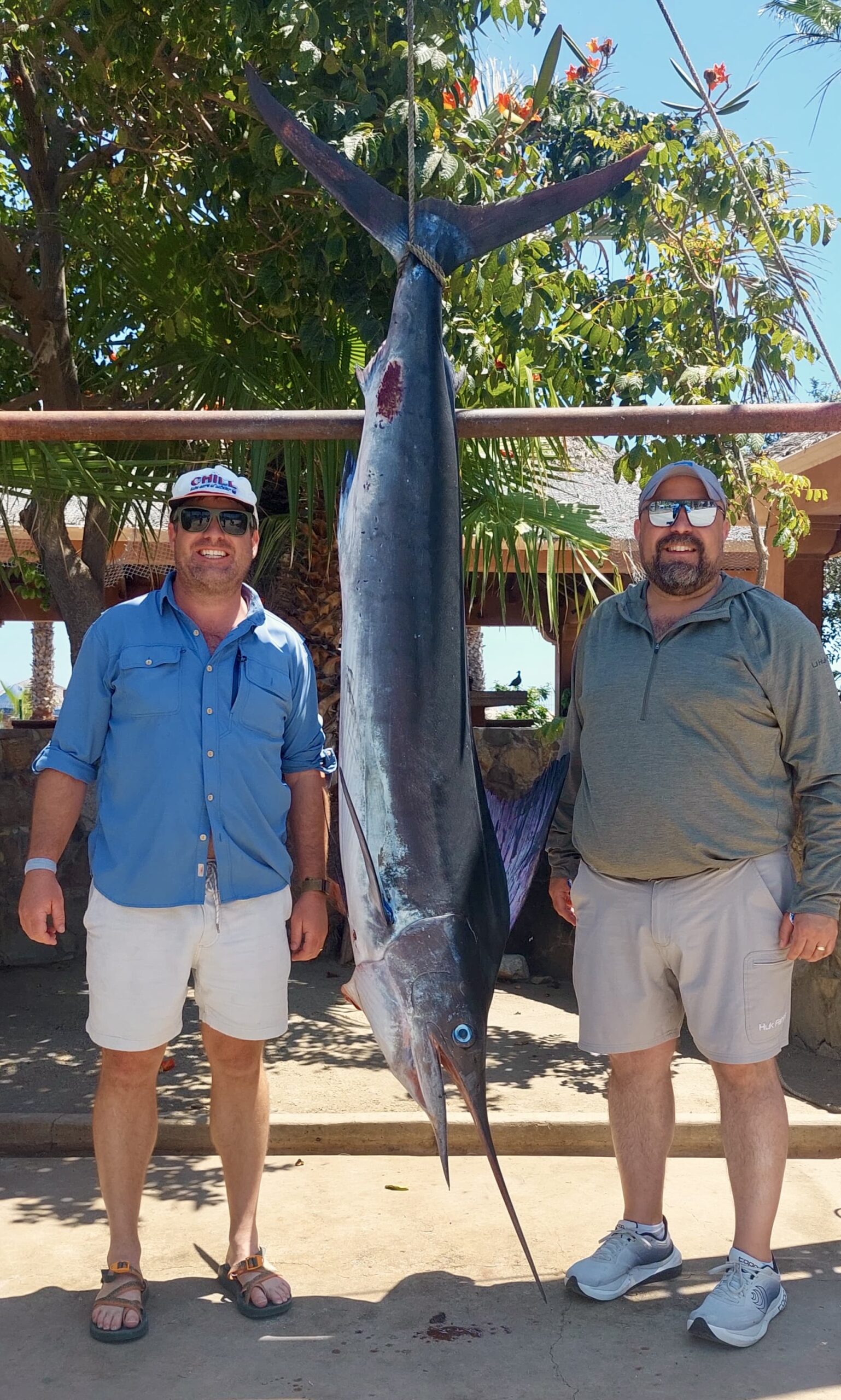
Marlin
The Complete Cabo San Lucas Guide
No other destination on Earth combines this many marlin species, this density of fish, and this scale of tournament infrastructure within reach of a single marina. Cabo San Lucas earned the title "Marlin Capital of the World" because the math supports it: three species year round, peer-reviewed scientific tagging studies that confirm Cabo as a primary habitat, and the richest billfish tournament on the planet returning every October since 1981.
Why Cabo Is the Marlin Capital of the World
The "Marlin Capital of the World" nickname is not marketing. It is a designation rooted in oceanography, biology, and 75 years of documented sportfishing history. The waters off Cabo San Lucas and San Jose del Cabo produce more marlin per square mile, across more species, more consistently throughout the year than any comparable destination on Earth.
What earns the title
- Three species available in the same waters. Blue, striped, and black marlin all inhabit Cabo waters during overlapping seasons. Most destinations specialize in one. Cabo offers the grand slam potential.
- Year round action. Striped marlin are present every month of the year, with peak from November through April. Blue and black marlin overlap from July through November.
- Geographic convergence. Cabo sits at the meeting point of the Pacific Ocean and the Sea of Cortez. The temperature breaks, current edges, and upwelling created at this junction concentrate baitfish and marlin year round.
- Deep water proximity. The 1,000 fathom curve sits closer to shore at Cabo than at virtually any other major sportfishing destination. Productive marlin water starts within 5 miles of the marina.
- Tournament infrastructure. The Bisbee's Black and Blue, the world's richest billfish tournament with a $7.4 million purse in 2025, has been held annually in Cabo since 1981.
- Documented release rates. Cabo fleets report 10 to 15 marlin releases per boat per day during peak striped marlin season, with over 300 marlin released in a three week stretch documented by Sport Fishing Television.
Identifying Cabo's Three Marlin Species
All three marlin species are members of the family Istiophoridae (billfish). To the untrained eye they can look similar, but the differences are meaningful for anglers planning a trip, captains targeting specific species, and conservationists tracking population health.
Side by side comparison
| Feature | Blue Marlin | Striped Marlin | Black Marlin |
|---|---|---|---|
| Scientific name | Makaira nigricans | Kajikia audax | Istiompax indica |
| IGFA record | 1,376 lb (Pacific) | 494 lb | 1,560 lb |
| Average Cabo size | 200 to 500 lb | 110 to 180 lb | 300 to 700 lb |
| Peak season Cabo | Jul to Oct | Nov to Apr | Aug to Nov |
| Body color | Deep cobalt blue back | Bright bars on flanks | Dark slate gray back |
| Pectoral fins | Flexible, folds against body | Flexible, folds against body | Rigid, fused at maturity |
| Dorsal fin height | Lower than body depth | Equal to or higher than body | Short, rounded |
| IUCN status | Vulnerable | Near Threatened | Data Deficient |
The grand slam
A marlin grand slam is the capture (or release) of three marlin species in a single day. Cabo is one of the few places on Earth where this is possible because all three species inhabit the same waters during overlapping seasons. The window for an attempt is roughly August through October when blue, striped, and black marlin are all available within the same fishing grounds. A super grand slam adds sailfish to the mix, and a fantasy slam adds swordfish to a super slam.
Blue Marlin: The Apex Predator
The blue marlin is the benchmark by which all offshore fishing is measured. Of all the pelagic species in the world's oceans, none commands more respect, attracts more anglers, or generates more legend than Makaira nigricans. Cabo waters consistently produce granders (fish over 1,000 pounds) and are the closest major fishery to the IGFA Pacific blue marlin world record grounds in Kona, Hawaii.
Blue Marlin (Pacific)
Highly migratory across entire ocean basins. The species most associated with the term "marlin." Notable for explosive aerial displays, sustained fights, and the cobalt blue iridescent flanks that earned the name. The vast majority of trophy fish are female, sometimes four times larger than males.
Anatomy and identification
- Deep cobalt blue back fading to silver white belly
- Pointed first dorsal fin height less than maximum body depth
- Faint vertical stripes on flanks (less pronounced than striped marlin)
- Pectoral fins flexible, fold flat against body
- Long pointed bill, approximately 20 percent of body length
- Females dramatically larger than males (males rarely over 300 to 350 lb)
The Pacific IGFA all tackle record
On May 31, 1982, Jay de Beaubien landed a 1,376 pound Pacific blue marlin off Kaaiwi Point, Kona, Hawaii. The fish measured 193 inches long with an 82 inch girth. De Beaubien used an Erskine rod with a Fin-Nor 12/0 reel spooled with 130 pound Erskine line, trolling a Kita lure. The record has stood for over four decades.
Choy's Monster: the largest ever
The largest blue marlin ever landed on rod and reel was a 1,805 pound female caught off Kona, Hawaii in 1970 by Captain Cornelius Choy. The fish was never certified by IGFA because the line was shared during the fight, but it remains widely accepted as the heaviest blue marlin ever brought to gaff with sport tackle.
Life history and biology
- Highly migratory, crossing entire ocean basins
- Atlantic and Pacific populations now classified as the same species (M. nigricans)
- Lifespan estimated 15 to 30 years
- Diet: tuna, mahi mahi, squid, mackerel
- Spawning in warm tropical waters, multiple times per season
- Apex predator with no natural predators except sharks on juveniles
Conservation status
The IUCN Red List classifies blue marlin as Vulnerable, based on stock assessments showing 33 to 37 percent decline across the species range over the past three generations (27 years from 1987 to 2014). The Pacific stock is currently the healthiest of the global populations. Cabo conservation practices include heavy emphasis on catch and release, with most charter operators including Daliken Sportfishing supporting release as the default for blue marlin not destined for tournament weigh ins.
For a complete deep dive into blue marlin fishing in Cabo, see our Blue Marlin fishing guide for San Jose del Cabo.
Striped Marlin: The Volume Species
If blue marlin are the trophy, striped marlin are the foundation of the Cabo fishery. Kajikia audax is by far the most abundant marlin species in Baja waters and the primary reason Cabo is called the striped marlin capital of the world. Peer reviewed satellite tagging research confirms that the eastern Pacific population uses Baja California Sur as a primary habitat during winter months.
Striped Marlin
The most acrobatic of the marlin species, known for jumping and tail walking displays during fights. Smaller than blue or black marlin but caught in greater numbers in Cabo than any other location on Earth. Charter fleets regularly report 10 to 15 releases per boat per day during peak season.
Anatomy and identification
- Dark blue dorsally, silver ventrally with 15 cobalt colored bars made of round dots and narrow bands
- First dorsal fin equal to or higher than body depth (key ID feature vs blue marlin)
- Slender body with rounded snout cross section
- 15 cobalt vertical bars distinctly visible on flanks
- Long pointed first dorsal fin
- Quality of flesh considered best among billfish for table fare
The IGFA all tackle record
The all tackle world record striped marlin is 494 pounds, caught by Bill Boniface on January 16, 1986 off Tutukaka, New Zealand. The fish measured 115.67 inches long with a 57 inch girth. Boniface used a Wilkinson Sports rod with a Penn International 50 reel spooled with 24 kilogram Ande line, trolling a kahawai (Australian salmon). The record has stood for nearly 40 years.
Peer reviewed habitat science
A 2015 study by Sippel et al. analyzed behavioral data from 159 pop up satellite archival tags deployed on striped marlin across the Pacific (Australia, New Zealand, Hawaii, Southern California, Baja California, Costa Rica, Panama, and Ecuador). The findings confirm striped marlin behavior with precision:
- Pronounced use of the mixed layer with at least 54 percent of time spent between 0 and 10 meters depth across all regions
- Surface oriented at night, moving slightly deeper during day
- Median tag deployment 61 days, maximum 259 days
- Strong site fidelity to known feeding zones, including Cabo San Lucas
Cabo as primary habitat
Multiple Mexican research institutions have documented Cabo's role as a primary striped marlin habitat. CICIMAR (Centro Interdisciplinario de Ciencias Marinas) published the doctoral dissertation "Ciclo reproductivo del marlin rayado (Kajikia audax) en Cabo San Lucas, Baja California Sur, Mexico" by Sevilla-Rodriguez in 2013, confirming reproductive activity in Cabo waters. Studies by Ortega-Garcia et al. (2003) analyzed sportfishing catch rates at Cabo and their relation to sea surface temperature, establishing Cabo as a benchmark fishery for the species.
The fall bite
Striped marlin action peaks in Cabo from November through April but the fall transition produces remarkable fishing. Sport Fishing Television documented a three week stretch in October where Cabo charters released over 300 marlin combined. Individual boats reported 10 to 15 marlin releases per day during the peak of this window. No other destination produces volume of this magnitude.
For a complete deep dive into striped marlin fishing in Cabo, see our Striped Marlin fishing guide for San Jose del Cabo.
Black Marlin: The Heaviest Fish on Rod and Reel
The black marlin holds the most prestigious record in all of sportfishing: the heaviest fish ever landed on rod and reel under IGFA rules. Istiompax indica is less common in Cabo than blue or striped marlin but is present every season, with documented Daliken Sportfishing catches including a 600 pound black marlin landed by Captain Ulices in August 2025.
Black Marlin
Apex predator and the largest member of the billfish family in absolute weight. Distinguished by rigid pectoral fins that do not fold against the body once the fish reaches maturity, a feature unique among marlin species. Indo-Pacific only, not found in Atlantic waters.
Anatomy and identification
- Dark slate gray to nearly black back, silver white belly
- Faint pale stripes that disappear quickly after death
- Rigid pectoral fins fused at maturity, do not fold against body (unique identification feature)
- Shorter, stouter bill than blue marlin
- Short, rounded first dorsal fin
- Indo-Pacific distribution only, not present in Atlantic waters
The most prestigious record in sportfishing
On August 4, 1953, Alfred C. Glassell Jr. landed a 1,560 pound black marlin aboard the vessel Petrel off Cabo Blanco, Peru. The fight lasted one hour and 45 minutes. The fish jumped 49 times during the battle. It measured 14 feet 6 inches in length with a 6 foot 9 inch girth. Glassell used a Tycoon rod with a size 12/0 Fin-Nor reel and 39 thread Ashaway line, trolling a cero mackerel as bait. The mounted specimen now hangs in the Alfred C. Glassell Jr. Hall of Tropical Pacific Marine Life at the Houston Museum of Natural Science.
The 1953 catch remains the largest fish ever landed on rod and reel under IGFA rules. Footage of the catch was used in the 1958 film adaptation of Ernest Hemingway's "Old Man and the Sea." The record has stood for over 70 years and is widely considered one of the most enduring marks in all of sportfishing.
Life history
- Lifespan estimated 30 to 40 years
- Apex predator targeting tuna, mackerel, squid, and other large baitfish
- Largest specimens documented with 150+ pound tuna inside their stomachs
- Females significantly larger than males (males rarely exceed 300 to 400 pounds)
- Spawning concentrations have been documented at specific seamounts and current convergences
Black marlin in Cabo
Black marlin are present in Cabo waters from late summer through fall, overlapping with the blue marlin peak season. While less abundant than blues or stripes, the species is consistently part of the catch reports during the Bisbee's Black and Blue tournament. The 2024 winning fish at Bisbee's was a 634 pound black marlin landed by Team Crudo. The 2023 record breaking $3.9 million single team payout went to Team Stella June for a 368 pound black marlin.
The Geography of Cabo's Marlin Grounds
The reason Cabo produces marlin so consistently is geographic. The Baja California peninsula terminates in a region where two distinct ocean systems converge, multiple seamounts rise within 20 miles of shore, and the continental shelf drops to abyssal depths almost immediately. Few places on Earth offer this combination.
The two ocean convergence
Cabo sits at the meeting point of the cooler Pacific Ocean to the west and the warmer Sea of Cortez to the east. The temperature breaks created where these water masses meet are exactly the conditions that concentrate baitfish and the marlin that hunt them. The convergence shifts seasonally, which is why different banks fish differently throughout the year.
The major marlin grounds
- Gordo Banks. 8 to 10 miles off Puerto Los Cabos Marina in San Jose del Cabo. A seamount system rising from over 3,000 feet to within 150 feet of the surface. Produces blue marlin July through October and striped marlin during winter peaks.
- Golden Gate Bank. 19 miles southwest of Cabo San Lucas. The historic striped marlin hotspot. Late winter and spring concentration zone.
- Finger Bank. 40 miles north of Cabo. A productive deep water structure that holds blue marlin during summer peaks.
- San Jaime Bank. South of Cabo, deep water marlin grounds for boats willing to make the run during peak blue marlin season.
- Iman Bank. Further offshore from San Jose del Cabo. Holds wahoo and marlin during overlapping seasons.
- 1150 Spot. 20 miles offshore from Cabo. Productive seamount during summer blue marlin season.
- Cabrillo Seamount. 28 miles north of Cabo. Off the beaten path for most charters but produces trophy fish.
The 1,000 fathom curve
Within 5 miles of the Cabo arch, ocean depths exceed 1,000 feet. The 1,000 fathom curve (6,000 feet of depth) sits closer to shore at Cabo than at virtually any other major sportfishing destination on Earth. This means the productive blue marlin water begins almost immediately upon leaving the marina, maximizing fishing time and minimizing transit time. A 30 to 45 minute run gets boats to legitimately productive marlin grounds.
Baitfish abundance
The Gordo Banks and adjacent structure attract massive concentrations of skipjack tuna, sardines, mackerel, ballyhoo, and squid. These are exactly the prey that marlin target. Cabo's marlin fishery is built on this base layer of bait, which the convergence currents and upwelling continually replenish year round.
The Bisbee's Black and Blue: The World's Richest
No conversation about marlin fishing in Cabo is complete without the Bisbee's Black and Blue. Founded in 1981 by the Bisbee brothers with just six teams, the tournament has grown into the richest billfish event on the planet and one of the largest prize purses in any sportfishing competition globally.
The 45th Annual Bisbee's Black and Blue, October 2025
The 2025 edition delivered a record breaking $7.4 million purse with 177 teams competing over three days of fishing. Team Magic Touch took top honors with a 459 pound blue marlin landed on the final day, backed by a 344 pound blue from Day Two. The fleet released 10 black marlin and 113 blue marlin combined during the event.
Bisbee's by the numbers across recent years
| Year | Total Purse | Teams | Notable |
|---|---|---|---|
| 2025 | $7,452,775 | 177 | Team Magic Touch wins with 459 lb blue |
| 2024 | $6,847,200 | 174 | Team Crudo, 634 lb black marlin |
| 2023 | $4.4 million | ~120 | Team Stella June $3.9M single payout (368 lb black) |
| 2019 | $4.5 million | 126 | 39th annual edition |
| 2006 | ~$4 million | ~110 | Team Bad Company $3.9M single payout (longstanding record) |
| 1981 | Founding | 6 | First annual edition |
How the tournament works
- Three days of fishing every October out of Cabo San Lucas marina
- Base entry fee approximately $5,000 USD per team
- Optional daily and event jackpots can push total team entry to $100,000 or more
- Qualifying fish must exceed minimum weight thresholds (currently 300 pounds for blue and black marlin)
- Striped marlin and undersized billfish must be released
- Weigh ins held at Puerto Paraiso Mall, drawing thousands of spectators
- Strict IGFA rules enforced including line class, gear, and tagging procedures
Why it matters for Cabo's marlin reputation
The Bisbee's draws elite teams from around the world. Charter captains, boat manufacturers, tackle companies, and pro anglers cycle through Cabo every October for the event. The economic impact runs into tens of millions of dollars annually. The tournament also brings massive press coverage, which over four decades has built and sustained Cabo's reputation as the marlin capital. The 80 percent catch and release rate at the 2024 tournament also signals a shift toward conservation that the broader fishery has adopted.
IGFA World Records and Historic Catches
The IGFA all tackle world records for the three marlin species represent the ultimate benchmarks for big game anglers. Some have stood for over 70 years and may never be broken.
All tackle world records
| Species | Weight | Angler | Location | Date |
|---|---|---|---|---|
| Black Marlin | 1,560 lb | Alfred Glassell Jr. | Cabo Blanco, Peru | Aug 4, 1953 |
| Atlantic Blue Marlin | 1,402 lb 2 oz | Paolo Amorim | Vitoria, Brazil | Feb 29, 1992 |
| Pacific Blue Marlin | 1,376 lb | Jay de Beaubien | Kona, Hawaii | May 31, 1982 |
| Striped Marlin | 494 lb | Bill Boniface | Tutukaka, New Zealand | Jan 16, 1986 |
| White Marlin | 181 lb 14 oz | Evandro Coser | Vitoria, Brazil | Dec 8, 1979 |
Historic marlin timeline
Ted Seeley Introduces Cabo Blanco
New York businessman Ted Seeley publicizes the giant black marlin fishery at Cabo Blanco, Peru. His findings spark interest from IGFA founder Michael Lerner and Texas oil entrepreneur Alfred Glassell Jr.
The 1,560 Pound Black Marlin
Alfred Glassell Jr. lands the all tackle world record black marlin off Cabo Blanco, Peru aboard the Petrel. The catch remains the largest fish ever landed on rod and reel under IGFA rules over 70 years later.
Hemingway's Old Man and the Sea Film
Footage of Glassell's 1,560 pound black marlin appears in the 1958 film adaptation of Hemingway's Old Man and the Sea, cementing the marlin's place in cultural mythology.
Choy's Monster
Captain Cornelius Choy boats a 1,805 pound blue marlin off Kona, Hawaii. The catch never received IGFA certification due to shared line during the fight but remains the largest blue marlin ever landed with sport tackle.
First Bisbee's Black and Blue
The Bisbee brothers launch the first Black and Blue tournament in Cabo with six teams. The event grows into the world's richest billfish tournament over the next four decades.
Pacific Blue Marlin Record
Jay de Beaubien lands a 1,376 pound Pacific blue marlin off Kaaiwi Point, Kona, Hawaii. The record stands to this day.
Striped Marlin Record
Bill Boniface lands a 494 pound striped marlin off Tutukaka, New Zealand. Nearly 40 years later the record still holds.
Atlantic Blue Marlin Record
Paolo Amorim lands a 1,402 pound 2 ounce Atlantic blue marlin off Vitoria, Brazil, setting the all tackle record that remains current.
Bisbee's Single Payout Record
Team Bad Company wins $3.9 million in a single day at the Bisbee's Black and Blue, setting the largest single team payout in tournament fishing history at the time.
New Single Payout Record
Team Stella June wins $3,906,550 USD at the 43rd Bisbee's Black and Blue, eclipsing the 2006 Bad Company record by $4,000 with a 368 pound black marlin caught on Day One.
$7.4 Million Purse
The 45th Annual Bisbee's Black and Blue produces a $7,452,775 USD purse, the largest in tournament history. Team Magic Touch wins with a 459 pound blue marlin.
Conservation, Catch and Release, and the Future of the Fishery
Marlin are apex predators with slow population recovery rates relative to their commercial and recreational fishing pressure. The IUCN Red List classifies blue marlin as Vulnerable, striped marlin as Near Threatened, and black marlin as Data Deficient pending sufficient population data. Cabo's reputation as the marlin capital depends on the long term health of the fishery, which is why catch and release has become the dominant practice.
Population status
| Species | IUCN Status | Trend | Notes |
|---|---|---|---|
| Blue Marlin | Vulnerable | 33 to 37% decline over 27 years (1987 to 2014) | Pacific stock healthiest globally |
| Striped Marlin | Near Threatened | Overfished in W and C North Pacific | Mexican Pacific population stable |
| Black Marlin | Data Deficient | Insufficient data globally | Indo-Pacific only |
Mexican fishing regulations
- Mexican law permits keeping 1 billfish per angler per day (any combination of marlin, sailfish, or swordfish)
- Mexican fishing license required for all anglers, available at the marina (around $20 USD)
- Tournament rules typically require release of striped marlin and any blue or black marlin under qualifying weights (currently 300 pounds for Bisbee's)
- Long line fishing for billfish is prohibited within Mexican territorial waters
Catch and release best practices
- Use circle hooks instead of J hooks when possible, dramatically reduce gut hooking
- Minimize fight time, longer fights produce higher post release mortality
- Keep the fish in the water during release, do not lift large marlin out of the water
- Cut the leader close to the hook rather than removing the hook from deeply hooked fish
- Revive the fish by holding it boat side and moving water through the gills before releasing
- Use IGFA approved tagging procedures if participating in scientific research
Daliken Sportfishing release ethos
At Daliken Sportfishing we support catch and release as the default practice for marlin. Exceptions are made for guests pursuing legitimate tournament weigh ins, IGFA records, or for fish that cannot be revived. All released fish are documented with photos and measurements when conditions permit. We use circle hooks on live bait rigs and follow IGFA best practices for handling and release. The future of the marlin capital depends on every charter operating this way.
Glossary of Marlin Fishing Terms
- Bait and switch
- A technique where teasers without hooks are pulled to raise a marlin, then a hooked live bait is pitched to the fish when it appears in the spread. Considered the most sportsmanlike marlin technique.
- Billfish
- The collective term for the family Istiophoridae (marlins, sailfish, spearfish) and Xiphiidae (swordfish), all of which feature an elongated bill or spear.
- Bridled bait
- A rigging technique where the hook is attached to a live baitfish via a bridle of waxed line or rubber band, allowing the fish to swim naturally while keeping the hook exposed.
- Bisbee's
- The Bisbee's Black and Blue Marlin Tournament, the world's richest billfish tournament held annually in Cabo San Lucas every October since 1981.
- Choy's Monster
- The 1,805 pound blue marlin landed by Captain Cornelius Choy off Kona, Hawaii in 1970. Never IGFA certified but widely accepted as the largest blue marlin ever brought to gaff with sport tackle.
- Daisy chain
- A teaser made of multiple plastic squids or fish in a row, pulled to simulate a school of bait and attract marlin to the boat.
- Grand slam
- The capture (or release) of three billfish species in a single day. A marlin grand slam requires blue, striped, and black marlin. A super grand slam adds sailfish. A fantasy slam adds swordfish.
- Grander
- A marlin weighing 1,000 pounds or more. The dividing line between exceptional and legendary catches.
- Greyhounding
- A jumping behavior where a hooked marlin makes a series of long, low jumps across the surface, similar to a greyhound running.
- IGFA
- The International Game Fish Association, the governing body that certifies sportfishing world records and maintains rules for tackle, line, and angling procedures.
- Istiophoridae
- The biological family of marlins, sailfish, and spearfish. All species feature elongated bills used for hunting.
- Kona heads
- A style of skirted trolling lure originally developed in Hawaii for marlin, characterized by a chrome or jet head that creates a smoke trail when pulled at trolling speed.
- Marlin Capital of the World
- The nickname for Cabo San Lucas reflecting its status as the most productive multi species marlin fishery on Earth.
- Pelagic
- Living in the open ocean rather than near the sea floor or coast. All marlin species are highly pelagic.
- Pitched bait
- A live or rigged bait cast to a marlin that has been raised to the boat by teasers. Requires fast hands and good coordination between angler and crew.
- Stand up tackle
- Rod and reel setups designed for fighting fish without a fighting chair, using a stand up belt and harness. Standard for most Cabo charters.
- Tail walking
- A behavior where a hooked marlin walks across the surface on its tail, particularly common in striped marlin.
- Teaser
- A hookless trolled object used to attract marlin to the boat. Teasers can be daisy chains, birds, dredges, or single hookless lures.
- Tournament boat
- A sport fisher specifically rigged and outfitted for billfish tournaments, typically 50 feet and larger, with outriggers, livewells, and fighting chair.
- Yellowfin run
- Cabo specific phenomenon where yellowfin tuna and marlin appear in the same waters simultaneously, particularly during summer and fall months at Gordo Banks.
Frequently Asked Questions
Why is Cabo San Lucas called the Marlin Capital of the World? +
Cabo earned the nickname because three marlin species (blue, striped, and black) are consistently available within the same fishing grounds, the geography produces year round action through the convergence of the Pacific Ocean and the Sea of Cortez, and the world's richest billfish tournament has been held annually in Cabo since 1981. No other destination on Earth combines this density of marlin, this variety of species, and this tournament infrastructure in such close proximity to a marina.
What marlin species can you catch in Cabo San Lucas? +
Three marlin species are regularly caught in Cabo waters: blue marlin (Makaira nigricans), the largest and most coveted, peak season July through October. Striped marlin (Kajikia audax), the most abundant and consistently available year round with November through April as peak. Black marlin (Istiompax indica), less common but present during late summer and fall.
What is the world record marlin? +
The IGFA all tackle world record marlin of any species is a 1,560 pound black marlin caught by Alfred Glassell Jr. on August 4, 1953 off Cabo Blanco, Peru. The fish measured 14 feet 6 inches with a 6 foot 9 inch girth and is considered the largest fish ever landed on rod and reel under IGFA rules. The Pacific blue marlin record is 1,376 pounds (Jay de Beaubien, Kona, Hawaii, 1982). The striped marlin record is 494 pounds (Bill Boniface, New Zealand, 1986).
How big do marlin get in Cabo? +
In Cabo waters, blue marlin typically run 200 to 500 pounds with regular fish over 700 pounds and granders (over 1,000 pounds) caught every season. Striped marlin average 110 to 180 pounds. Black marlin range widely but trophy fish over 500 pounds are caught most seasons. The Bisbee's Black and Blue tournament regularly produces blues over 600 pounds.
What is the Bisbee's Black and Blue tournament? +
The Bisbee's Black and Blue is the world's richest billfish tournament, held annually in Cabo San Lucas every October since 1981. The 2025 tournament featured 177 teams competing for a $7.4 million purse. Team Bad Company set a single team payout record of $3.9 million in 2006, later eclipsed by Team Stella June with $3,906,550 in 2023.
When is marlin season in Cabo San Lucas? +
Marlin season in Cabo runs year round but varies by species. Striped marlin peak November through April with consistent fish year round. Blue marlin peak July through October when warmer surface water arrives. Black marlin appear primarily late summer and fall. October is the peak of all three species overlap, coinciding with tournament season.
What is a marlin grand slam? +
A marlin grand slam is the capture or release of three marlin species in a single day: blue, striped, and black. Cabo is one of the few places on Earth where this is possible because all three species inhabit the same waters during overlapping seasons. The window for an attempt is August through October. A super grand slam adds sailfish, and a fantasy slam adds swordfish.
Should you release marlin? +
Yes. Mexican law permits keeping one billfish per angler per day, but international conservation best practices and IGFA guidance strongly encourage catch and release for marlin. The Bisbee's tournament released 80 percent of marlin in 2024. Blue marlin populations are classified Vulnerable by IUCN with documented declines of 33 to 37 percent over the last three generations. Daliken Sportfishing supports catch and release as the default practice.
What technique do you use for marlin? +
The standard techniques are trolling skirted lures at 7 to 10 knots, slow trolling live bait like mackerel or skipjack tuna, and bait and switch where teasers raise the marlin to the surface for a pitched live bait. Captain choice depends on conditions, species targeted, and angler experience. Stand up tackle in the 50 to 130 pound class is standard.
What does a marlin charter cost in Cabo? +
Private marlin charters with Daliken Sportfishing start from $450 USD on the 28 ft Habanero. Larger offshore boats including the 33 ft Abamar and 35 ft Tiara are priced higher and include captain, mate, tackle, ballyhoo, water and ice. Specialized tournament rigged sportfishers run higher again, depending on length and capability.
References
- International Game Fish Association. All Tackle World Records: Marlin. IGFA World Records Database. igfa.org
- IUCN Red List. Makaira nigricans (Blue Marlin), 2022 Assessment. Vulnerable status. iucnredlist.org
- Sippel, T., et al. Habitat characterization for striped marlin in the Pacific Ocean. Fisheries Research, 2015. Multi region pop-up satellite archival tagging study, 159 tags.
- Acosta-Pachon, T. A., et al. Habitat preferences of striped marlin (Kajikia audax) in the eastern Pacific Ocean. Fisheries Oceanography, Wiley, 2017.
- Ortega-Garcia, S., Klett-Traulsen, A., Ponce-Diaz, G. Analysis of sportfishing catch rates of striped marlin at Cabo San Lucas, Baja California Sur, Mexico, and their relation to sea surface temperature. Marine and Freshwater Research, 2003.
- Sevilla-Rodriguez, H. Ciclo reproductivo del marlin rayado (Kajikia audax) en Cabo San Lucas, Baja California Sur, Mexico. CICIMAR Doctoral Dissertation, 2013.
- Bromhead, D., et al. Investigating Behaviour and Population Dynamics of Striped Marlin from the Southwest Pacific Ocean with Satellite Tags. PLOS One, 2011.
- Marlin Magazine. The Big Five: Largest Marlin and Swordfish IGFA World Records. 2025. Documentation of Glassell, de Beaubien, Boniface, Amorim records.
- Marlin Magazine. Bisbee's Black and Blue 2024 and 2025 Tournament Recaps. Annual coverage of the world's richest billfish tournament.
- Bisbee's Offshore Fishing Tournaments. Tournament Records and Payouts 1981 to 2025. bisbees.com
- Houston Museum of Natural Science. The Alfred C. Glassell Jr. Hall of Tropical Pacific Marine Life. Display of the 1,560 pound IGFA all tackle world record black marlin.
- Pelagic Gear. Species Profile: Blue Marlin (Makaira nigricans). Documentation of Choy's Monster 1,805 pound catch and Pacific records.
- Daliken Sportfishing. Local fish reports, captain interviews, and operational data, San Jose del Cabo, 2025 to 2026.
Fish the Marlin Capital
The waters that produced the world's largest fish on rod and reel, the world's richest billfish tournament, and three marlin species in the same fishing grounds. Daliken Sportfishing runs private marlin charters from Puerto Los Cabos Marina year round.