Fishing charters San Jose del Cabo

roosterfish complete guide cabo san lucas

Roosterfish: The Complete Cabo San Lucas Guide | Daliken Sportfishing Encyclopedia
The Complete Encyclopedia

Roosterfish
The Cabo San Lucas Guide

The definitive guide to the Pacific endemic that exists nowhere else on Earth. Sole member of its genus, family, and suborder. Holder of a 65 year IGFA world record set in Baja California. The unrivaled icon of inshore sportfishing.

World Record 114 lbs Set Baja Mexico, 1960 Range Mexico to Peru Only

The roosterfish exists nowhere else on Earth except the eastern Pacific coast of the Americas. It is the only species in its genus. The only species in its family. The only species in its entire suborder. You cannot catch a roosterfish in Hawaii, the Bahamas, Australia, or anywhere else on the planet. The IGFA world record has stood for 65 years and was set in Baja California, Mexico. This is the encyclopedia of an icon that belongs uniquely to these waters.

01
The Endemic Predator

The Fish That Exists Nowhere Else

Of all the trophy gamefish on Earth, the roosterfish occupies a unique place in sportfishing. While blue marlin can be chased in the Atlantic, Pacific, and Indian Oceans, while tuna and wahoo are circumtropical, the roosterfish is geographically locked to one narrow corridor of ocean: the eastern Pacific coast of the Americas, from the Gulf of California in Mexico south to Peru.

Geographic Exclusivity

Found Only Along One Coast

The roosterfish (Nematistius pectoralis) is endemic to the eastern Pacific Ocean. The species has never been documented anywhere else despite over 160 years of scientific record. This means that if you want to catch a roosterfish, you must travel to one of these specific destinations:

  • Mexico (Baja California Sur is the global epicenter)
  • Guatemala, El Salvador, Nicaragua (Central American Pacific coast)
  • Costa Rica and Panama (multi species tropical destinations)
  • Colombia, Ecuador, Peru (the southern range)

Why this matters for anglers

Most trophy gamefish offer anglers multiple destinations to chase them. A wahoo angler can fish Cabo, the Bahamas, Hawaii, or Roatán. A blue marlin angler has options across two oceans. A roosterfish angler has exactly one coastline of choices, and Baja California Sur is widely considered the premier destination within that corridor.

Anyone who has caught roosterfish knows that Mr. Nematistius pectoralis is one bad-ass mamma jamma that can damage both tackle and feelings. Though superficially similar to the Jack family, roosterfish are literally in a league of their own. Sport Fishing Magazine
02
The Species

Nematistius pectoralis: Sole Member of an Entire Family

Most fish species share their genus with at least one other species. Many share their family with dozens. The roosterfish stands apart at three levels of taxonomic isolation: it is the sole species in its genus, the sole species in its family (Nematistiidae), and the sole species in its entire suborder (Nematistioidei). This degree of phylogenetic isolation is exceptionally rare in marine biology.

5'3"
Max Length

1.6 m total length documented. Cabo roosters typically run smaller.

114 lb
IGFA Record

Set in 1960 at La Paz, Mexico. One of the longest standing records in sportfishing.

7
Dorsal Spines

The signature rooster comb that gives the species its common name.

1862
First Described

By American ichthyologist Theodore Gill from Smithsonian specimens.

Names across cultures

  • English: Roosterfish, rooster
  • Spanish (Mexico): Papagayo, pez gallo
  • Spanish (Central America): Gallo, pez gallo
  • Scientific: Nematistius pectoralis

Taxonomic classification

RankClassification
KingdomAnimalia
PhylumChordata
ClassActinopterygii (ray finned fishes)
OrderCarangiformes
SuborderNematistioidei (monotypic, sole suborder)
FamilyNematistiidae (monotypic, sole family)
GenusNematistius (monotypic, sole genus)
SpeciesN. pectoralis
AuthorityT. N. Gill, 1862
IUCN StatusLeast Concern

The discovery story

The species was first described in 1862 by American ichthyologist Theodore Nicholas Gill from specimens at the Smithsonian Institution collected by naturalist John Xantus during his expeditions to Baja California. The same year Gill described the species, he established the family Nematistiidae specifically to accommodate it, because the fish did not fit cleanly within any existing taxonomic family. Over 160 years of subsequent research has confirmed Gill's original assessment: the roosterfish stands alone.

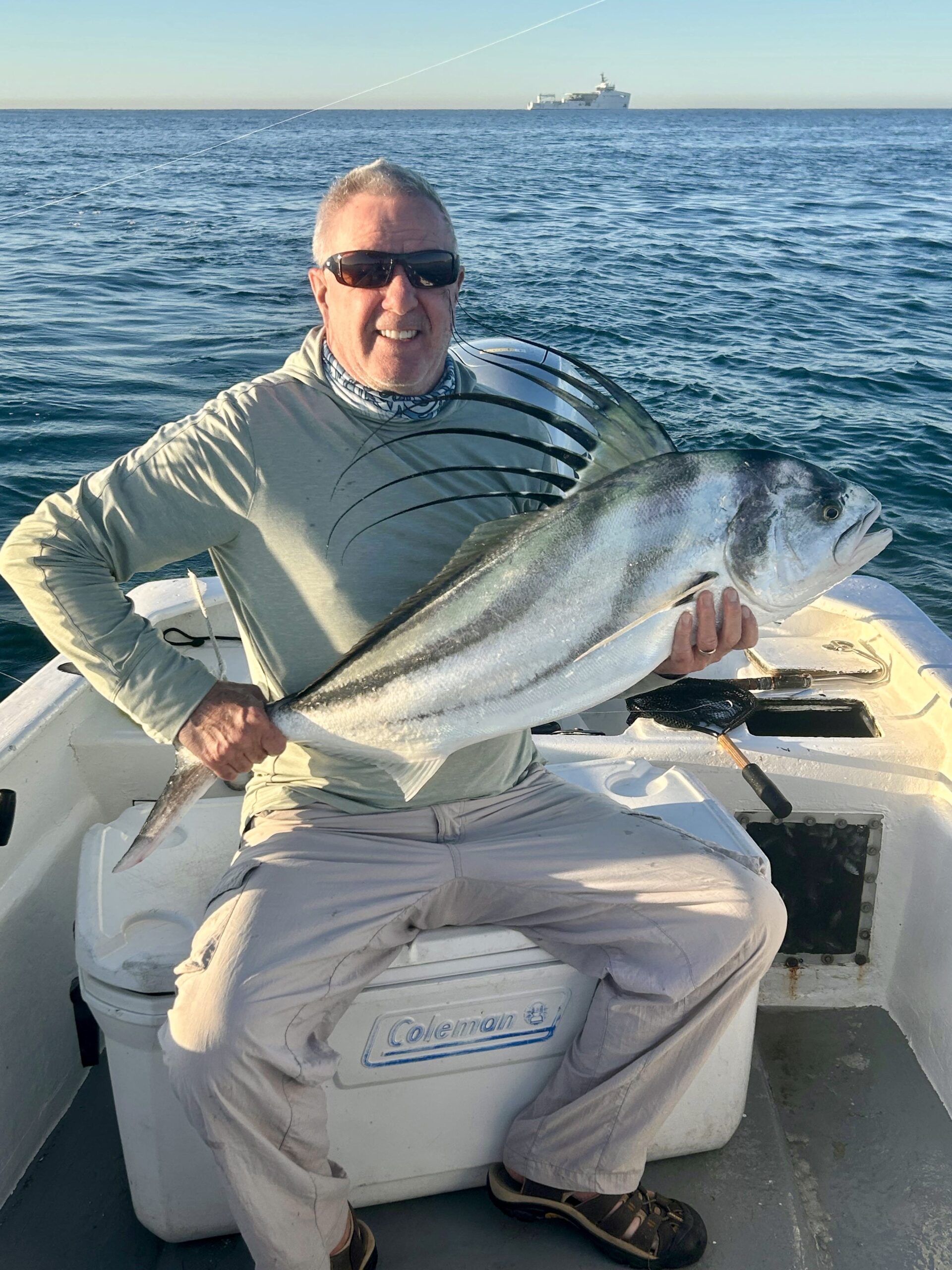
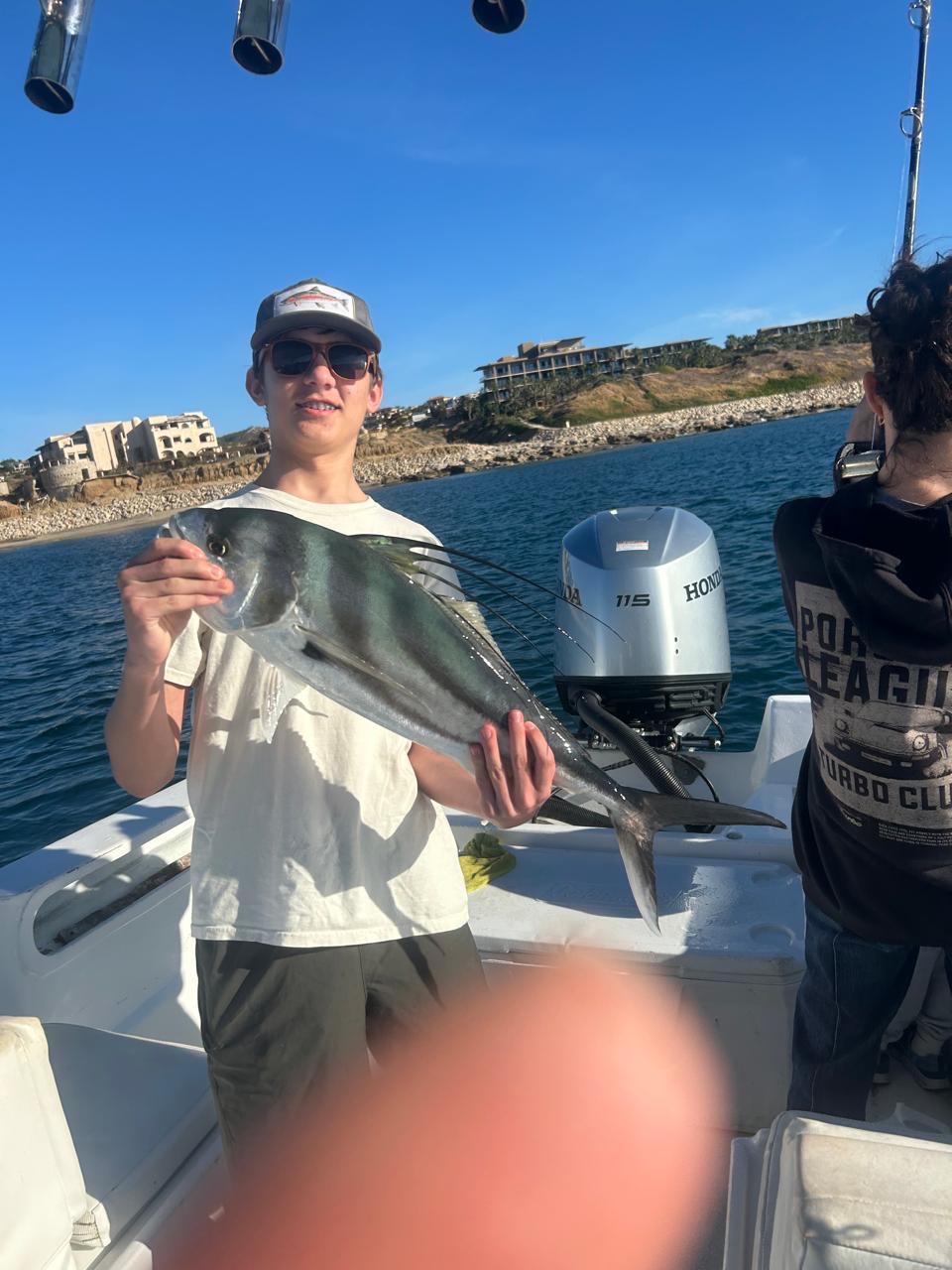
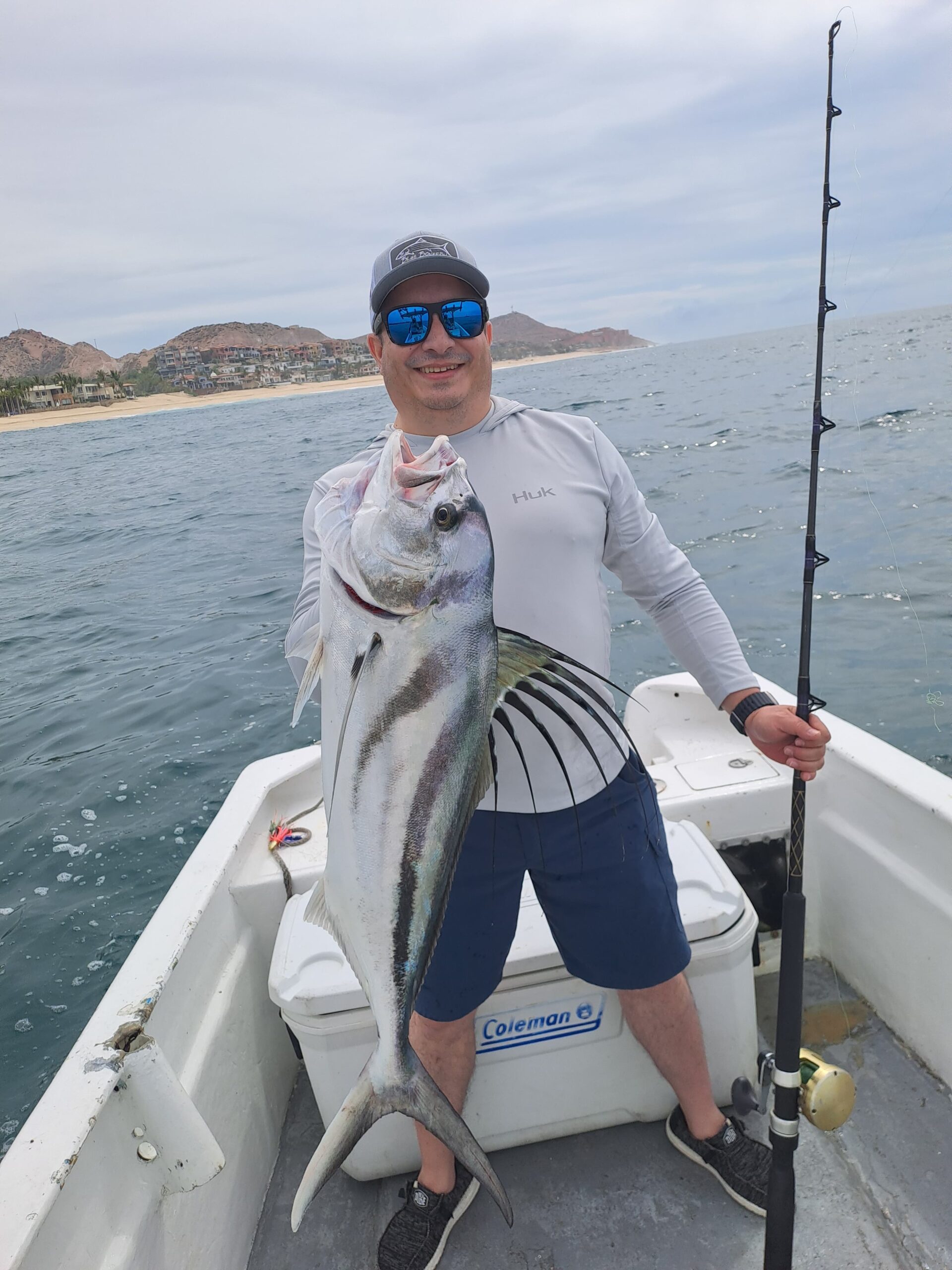
Pacific roosterfish Nematistius pectoralis landed in Cabo with Daliken Sportfishing
Roosterfish landed off San Jose del Cabo. The species exists only along the Pacific coast of the Americas, from Mexico to Peru.
03
Anatomy

The Rooster Comb and Other Distinctive Features

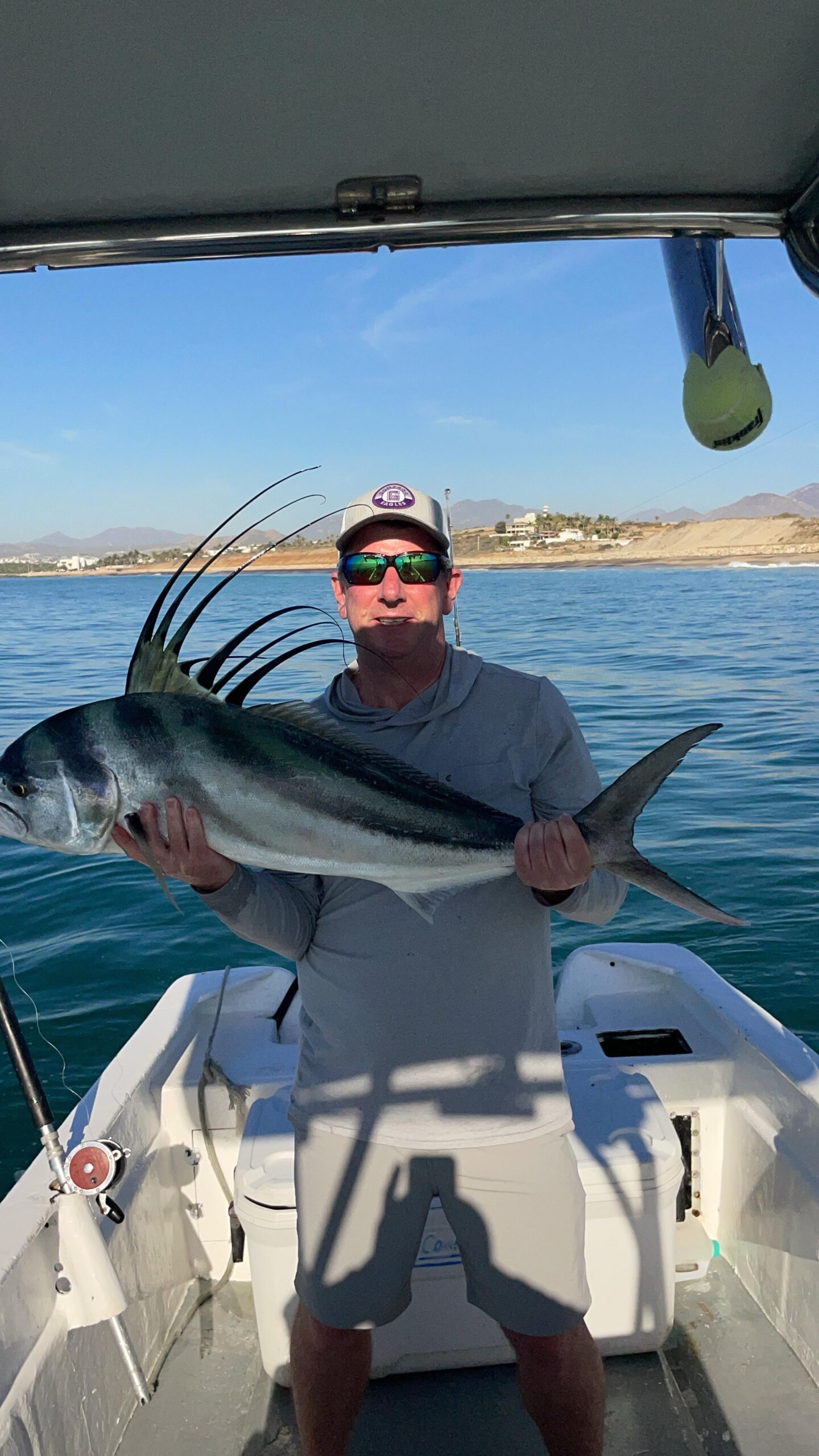
The roosterfish gets its common name from one of the most spectacular anatomical features in the marine world. Seven long, thread like dorsal spines arch above the body when the fish is excited, hooked, or pursuing prey. At rest, these spines fold neatly into a deep groove along the back. The transformation is dramatic.

The rooster comb

  • Seven elongated dorsal spines that give the species its name
  • Hidden at rest in a deep groove along the back, making the fish appear ordinary
  • Erected when excited by feeding aggression, hookup, or chase
  • Threadlike texture, with each spine flexible at the tip
  • Visual signaling, possibly used for communication between fish or intimidation of prey

Body markings

  • Two dark curved stripes (electric blue to black) running diagonally along the body
  • One dark stripe across the head, above the eye
  • Large dark spot at the base of the pectoral fin
  • Silver to bronze body coloration with iridescent flanks
  • Pale belly fading to silver white

Body plan and physiology

  • Compressed body shape similar to jacks (Carangidae) but distinct in proportions
  • Powerful caudal peduncle with bony external scutes for tail thrust
  • Large mouth for size, capable of inhaling whole baitfish
  • Strong pectoral fins for sudden lateral movements during pursuit
  • Estimated maximum burst speed among the fastest of inshore species
Roosterfish with erect dorsal comb caught surfcasting from San Jose del Cabo beach
The signature rooster comb in full display. When a roosterfish chases bait or fights against the line, the seven dorsal spines spring erect like a battle flag.

Behavior at the strike

When a roosterfish takes a bait or hits a lure, the comb springs to full erection in an instant. The fish typically responds with a long horizontal run rather than diving, often greyhounding across the surface with the comb flagging above the water. Watching a hooked rooster with its comb fully extended pursue a lure or fight the line is one of the most visceral experiences in sportfishing.

04
The Record

The 65 Year IGFA World Record from Baja

On June 1, 1960, Abe Sackheim landed a 114 pound roosterfish off La Paz, Baja California Sur, Mexico. The catch became the IGFA all tackle world record for the species. Today, more than six decades later, that record still stands. It is widely cited as one of the longest standing IGFA records in any saltwater species, a testament both to the extraordinary size of Sackheim's fish and to the elusive nature of trophy class roosterfish.

IGFA All Tackle World Record

114 Pounds, La Paz Mexico, June 1, 1960

Abe Sackheim landed the record off La Paz, Baja California Sur. The fish measured 64 inches in length with a 33 inch girth. Sackheim was trolling at the time of the strike, using a Penn 250 reel matched with a Miltcraft rod and 9 thread Ashaway Dacron line (27 pound test by modern conversion). The catch also stands as the 30 pound line class record. The mark has held for over 65 years and is considered among the most enduring records in saltwater sportfishing.

Timeline of roosterfish records and notable catches

1862

Species First Described

Theodore Gill describes Nematistius pectoralis from Smithsonian specimens collected by John Xantus in Baja California. Establishes the family Nematistiidae specifically to accommodate the unique species.

June 1, 1960

Sackheim Sets the Record

Abe Sackheim lands a 114 pound roosterfish at La Paz, Baja California Sur, Mexico. The fish measures 64 inches with a 33 inch girth. Caught trolling with a Penn 250 reel and Miltcraft rod. The IGFA all tackle and 30 pound line class records are simultaneously established.

2013

The 135 Pound Release

Angler Ron Burgess catches and releases an estimated 135 pound roosterfish at Las Arenas, off the East Cape of Baja. Multiple experienced sportfishing captains agree the fish would have weighed at least 134 pounds, easily exceeding Sackheim's record. Burgess chooses to release the fish rather than weigh it, prioritizing conservation over a record submission.

August 2021

Fly Tackle Length Record

Richard H. Rygg sets the IGFA all tackle length record for fly fishers with a 132 cm roosterfish at Cerralvo Island, just off the east coast of Baja in the Sea of Cortez. The record confirms the East Cape as the global center of trophy roosterfish fly fishing.

2026

Record Still Standing

66 years after Sackheim's catch, no angler has officially landed a heavier roosterfish under IGFA rules. The Baja California waters where the record was set continue to produce the largest roosters documented anywhere in the species range.

Despite over 65 years of intensive sportfishing pressure across the entire range of the species, Abe Sackheim's 114 pound roosterfish has never been surpassed under IGFA rules. The record persists as one of the most enduring in saltwater sportfishing.
05
The Waters

The Geography of Roosterfish Country

Within the species range from the Gulf of California to Peru, certain stretches of coastline produce significantly more trophy class roosterfish than others. The reasons are oceanographic: water temperature, baitfish concentrations, beach topography, and the convergence of currents. Baja California Sur stands out across all metrics.

The major roosterfish grounds

  • Rooster Alley (East Cape, Baja). A 30 mile stretch from Las Arenas south along the Baja California peninsula. Widely referred to as the Roosterfish Capital of the World. Rancho Leonero is the legendary lodge anchoring this fishery. The largest documented roosterfish in modern history (the 2013 Ron Burgess release of an estimated 135 pound fish) came from this zone.
  • La Paz region. Site of the 1960 world record. The bays and islands around La Paz produce trophy fish consistently each season, with Cerralvo Island accessible from the city as a particularly productive zone.
  • Cerralvo Island. Uninhabited island off the east coast of Baja in the Sea of Cortez. Site of the 2021 fly tackle length record. Accessed by panga from Las Arenas and Bahía de los Sueños.
  • San Jose del Cabo beaches. La Playita, Costa Azul, and the estuary zone produce consistent inshore action. Daliken Sportfishing operates direct access to these waters.
  • Magdalena Bay (Pacific side). Northern Pacific stretch of Baja, less pressured, holds roosters during seasonal migrations.
  • Tropical destinations south. Costa Rica (Crocodile Bay, Quepos), Panama (Tropic Star Lodge, Bahía Piñas), Ecuador (occasionally the largest specimens), Peru (the southern range).

Why East Cape and Cabo lead the global fishery

  • Two ocean convergence. The Pacific Ocean and Sea of Cortez meet at Cabo, creating temperature breaks that concentrate baitfish year round.
  • Beach topography. Sandy bottoms transitioning to rocky points create the ambush structure roosters hunt along.
  • Baitfish abundance. Sardines, mullet, and ballyhoo populations are exceptional through the warm months.
  • Accessible from shore and panga. Many of the best zones can be fished from beach, from small boat, or from kayak, opening the fishery to anglers of all preferences.
  • Documented record history. The two most significant roosterfish events in IGFA history (1960 world record, 2013 estimated record release) both occurred within 100 miles of each other in Baja California Sur.

Limited migration, local stocks

According to IGFA, roosterfish are not particularly far ranging, with maximum movement estimated at approximately 300 miles. This means the trophy fish caught off Baja stay regional throughout their lives. Healthy local populations depend on local conservation practices. When anglers release the fish they catch in Baja, those fish remain in Baja for future seasons.

06
When to Go

Roosterfish Season in Cabo and Baja

Roosterfish are present in Cabo waters every month of the year, but size and density change with the calendar. Understanding the seasonal cycle is essential for anglers planning a serious trophy trip.

Month by month

MonthActivityNotes
JanuaryQuietFish present but in deeper, cooler water. Average size smaller.
FebruaryQuietContinued slow period, fish further from beaches.
MarchAwakeningFirst warm water signals, action picks up at El Cardonal and East Cape.
AprilBuildingFish moving closer to shore, average size growing.
MayPeak beginsHeaviest roosters of the year start appearing. East Cape "Rooster Alley" lights up.
JunePeakBest month historically for trophy class fish. Cerralvo Island productive.
JulyPeakContinued action, often coinciding with summer billfish overlap.
AugustPeakWarmer water keeps fish close to beach. Surfcasting and panga action both excellent.
SeptemberPeakTropical conditions, hurricane window. Best days produce limit class fish.
OctoberLate peakFinal productive month before cooler water arrives. Solid action continues.
NovemberTaperingCooler water pushes fish offshore, average size dropping.
DecemberQuietOff season. Some fish caught incidentally on multi species trips.

The trophy window: May through July

If a true trophy roosterfish is the trip goal, plan for May, June, or July. The heaviest fish of each season historically appear during this three month window in the East Cape region. Water temperatures hit the optimal range, baitfish are abundant, and the largest females (which contain the maximum size potential) are most active in shallow water.

Conditions that produce trophy fish

  • Surface water temperatures 75 to 82 F along the East Cape beaches
  • Active baitfish concentrations (sardines, mullet) visible from the panga or shore
  • Calm to moderate wind, particularly during dawn and dusk windows
  • Moving tide cycles, the periods between low and high tide
  • Clear water with good visibility for sight casting and fly presentation
  • Recent rains can stir nutrients and trigger feeding activity
07
How to Catch Them

Three Ways to Catch a Roosterfish

Unlike most offshore gamefish that require a single approach, roosterfish can be targeted with three completely different techniques. Each appeals to different angler preferences and produces different experiences. Daliken Sportfishing offers all three depending on guest preference and conditions.

Most Productive

Live Bait from Panga

The traditional Baja method and historically the most productive. Live sardines or mullet bridled to circle hooks are slow trolled or drifted near rocky points, river mouths, and structure breaks.

  • 15 to 30 lb class spinning tackle
  • 40 to 60 lb fluorocarbon leader
  • Live sardines or live mullet preferred
  • Slow trolling 2 to 3 knots or anchored drift
  • Best at sunrise and sunset on moving tides
Ultimate Challenge

Surfcasting from Beach

The ultimate test of skill and stamina. Anglers walk the beach scanning for cruising roosters or feeding activity, then cast lures across the breakers to reach the fish.

  • 10 to 13 ft graphite composite spinning rod
  • High capacity spinning reel with fast retrieve
  • 30 to 65 lb braided main line, 300 yards capacity
  • 60 to 80 lb mono shock leader
  • Pencil poppers, Krocodiles, Kastmasters, Rapalas
  • Sebile Stick Shad as a subsurface alternative when fish are finicky
Fly Fishing Pinnacle

Fly Fishing

Considered one of fly fishing's greatest prizes. Anglers sight cast to cruising roosters from beach or panga using large baitfish patterns and aggressive retrieves.

  • 9 to 10 weight rod for medium fish
  • 10 to 12 weight for trophy class fish
  • Clear intermediate sinking line preferred
  • Baitfish pattern flies, large and aggressive
  • Double haul casting with quick delivery
  • Fast retrieve to trigger predatory response

The bait and switch technique

One particularly effective method, especially when fish are selective, is the bait and switch. The captain pulls hookless teasers or chum slick from the boat to attract a rooster to the surface. When the fish appears, the angler pitches a live bait or lure directly to it. This creates an explosive presentation that often triggers strikes when standard trolling does not work. The technique requires fast hands and good coordination between angler and crew.

What to expect in the fight

A hooked roosterfish typically responds with a long horizontal run rather than a deep dive. The fight is fast, powerful, and often acrobatic, with the fish greyhounding across the surface and tail walking with the comb fully erect. Trophy class roosters can run 200 yards or more on the initial sprint. Fights typically last 15 to 45 minutes depending on tackle weight and fish size, with larger fish taking proportionally longer.

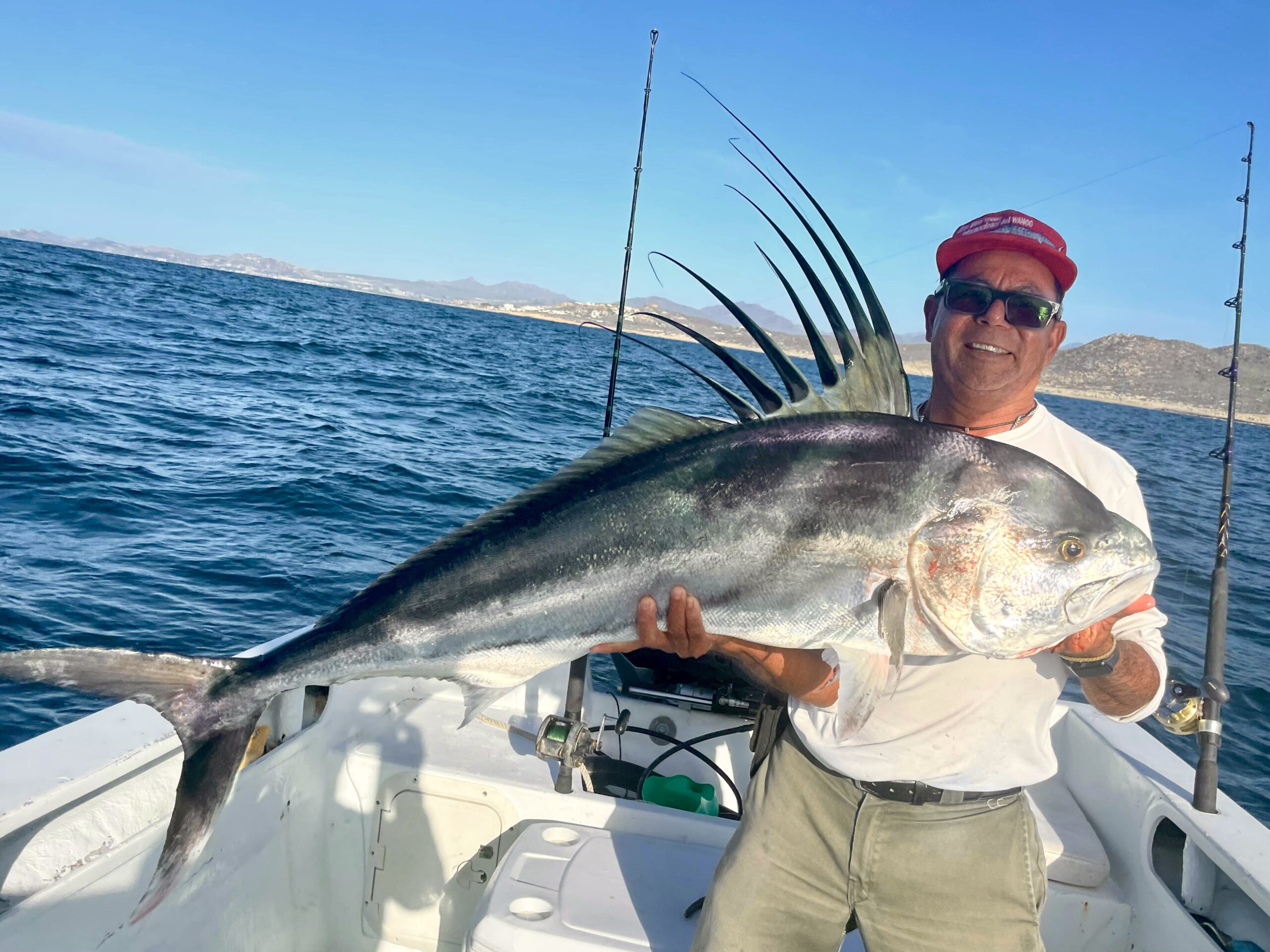
Daliken Sportfishing captain with roosterfish landed in Cabo San Lucas
A Daliken Sportfishing captain with a roosterfish landed off Puerto Los Cabos. Local knowledge of the beaches, tides, and bait patterns is the determining factor in successful trips.
08
Sustainable Fishing

Conservation and the Catch and Release Ethos

Roosterfish are an understudied species relative to other major gamefish, and their slow growth combined with limited migratory range makes them particularly vulnerable to over harvest. The most responsible Cabo charter operators have adopted catch and release as the default practice for roosterfish, with Daliken Sportfishing among them.

Conservation status

ParameterStatus
IUCN Red ListLeast Concern
CITESNot listed
Mexican lawRecreational catch limit applies (1 per angler per day under inshore gamefish category)
Commercial fisheryLimited artisanal harvest, mostly subsistence
Population trendStable but understudied, limited population data globally

Why catch and release matters for roosterfish specifically

  • Slow growth. Roosterfish grow significantly slower than tunas, dorado, or other warm water species. A trophy class fish represents many years of growth.
  • Limited migration. IGFA estimates maximum movement at approximately 300 miles. Released fish stay in the local fishery for future seasons.
  • Poor table fare. The flesh is widely considered inferior to other inshore species. There is no culinary reason to keep them.
  • Tournament catch and release. Major roosterfish tournaments worldwide have moved to release only formats.
  • Conservation example. Ron Burgess released an estimated 135 pound roosterfish in 2013, choosing the long term health of the fishery over a world record. This ethic now defines responsible roosterfish fishing globally.

Best practices for release

  • Use circle hooks instead of J hooks to dramatically reduce gut hooking
  • Minimize fight time to reduce stress and post release mortality
  • Keep the fish in the water during release whenever possible
  • Support the fish horizontally if it must be lifted briefly for a photo
  • Revive the fish by holding it boat side or beach side and moving water through the gills before release
  • Cut leaders close to deeply set hooks rather than removing them
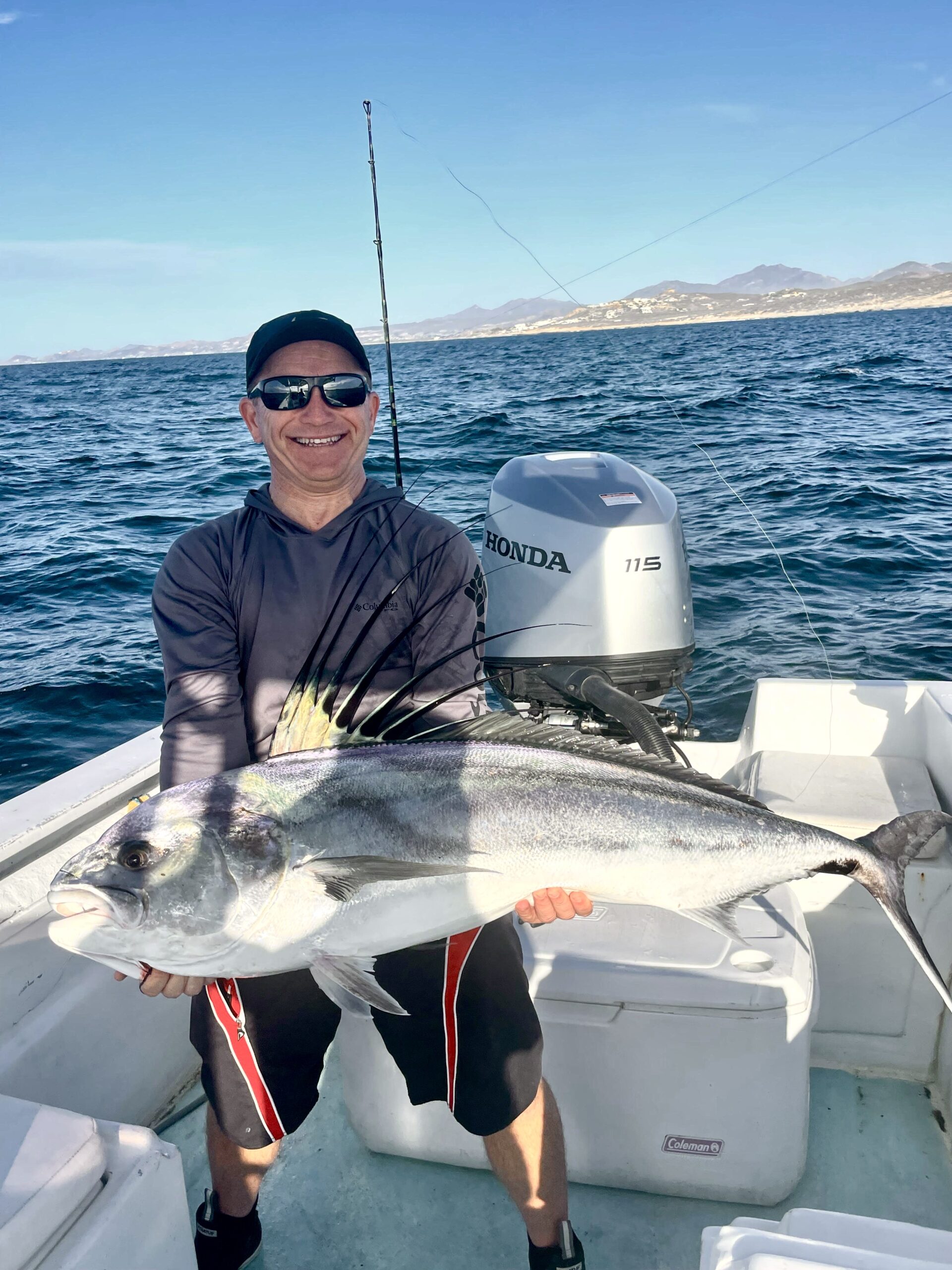
Roosterfish catch and release Cabo San Lucas Baja California
Catch and release is the default practice for roosterfish at Daliken Sportfishing. The species grows slowly and the local population stays local, so the future of the fishery depends on releases today.
Anglers who release the roosters they catch in Baja are investing directly in the future of the fishery. With a maximum migration range of about 300 miles, the fish you let go today will still be here next season.
Reference

Glossary of Roosterfish Terms

Bay of Dreams
English name for Bahía de los Sueños on the East Cape of Baja California Sur, a premier destination for fly fishing roosterfish from beach and panga.
Cerralvo Island
Uninhabited island in the Sea of Cortez off the east coast of Baja near Las Arenas. Site of the 2021 IGFA fly tackle length record for roosterfish.
Comb
The signature crest of seven elongated dorsal spines that gives the roosterfish its common name. Folds into a groove at rest, erects when excited.
East Cape
The Pacific facing stretch of Baja California Sur from Cabo Pulmo north to La Paz. Premier roosterfish habitat globally.
Endemic
A species found only in one specific geographic region. The roosterfish is endemic to the eastern Pacific coast of the Americas.
Greyhounding
A behavior where a hooked fish makes a series of long horizontal jumps across the surface, similar to a greyhound running. Common in roosterfish fights.
IGFA
International Game Fish Association, the governing body that certifies sportfishing world records.
Las Arenas
Small fishing village on the East Cape of Baja California Sur. Northern anchor of the 30 mile Rooster Alley.
Live bait
Whole live baitfish used as terminal bait. For roosterfish, typically sardines or mullet hooked to swim naturally.
Monotypic
A taxonomic group containing only one species. The roosterfish is monotypic at the genus, family, and suborder levels.
Nematistiidae
The biological family that contains the roosterfish and no other species. Established by Theodore Gill in 1862 specifically for Nematistius pectoralis.
Panga
The traditional Baja open fishing boat, typically 22 to 26 feet, used by local captains for inshore trips. Daliken's Super Panga 23 ft and 26 ft are modernized versions.
Pez gallo
The Spanish name for roosterfish, translating literally to "rooster fish."
Popper
A topwater lure designed to create surface commotion when retrieved. Pencil poppers are particularly effective for roosterfish.
Rancho Leonero
Legendary fishing lodge on the East Cape, anchoring the Rooster Alley fishery and credited with much of the global recognition of roosterfish.
Rooster Alley
The 30 mile stretch of East Cape coastline from Las Arenas south, widely referred to as the Roosterfish Capital of the World.
Sardina
Spanish for sardine, the primary live bait used for roosterfish in Baja waters.
Sight casting
The technique of spotting individual fish or schools before casting, rather than blind casting. Premier roosterfish fly fishing technique.
Surfcasting
Fishing from the beach by casting lures or baits past the breaker line into deeper water. The ultimate challenge for shore based roosterfish anglers.
Tail walking
A behavior where a hooked fish walks across the surface on its tail. Common in greyhounding roosterfish fights.
Common Questions

Frequently Asked Questions

Where can you catch roosterfish?
Roosterfish are endemic to the eastern Pacific coast of the Americas, from the Gulf of California in Baja Mexico south to Peru. They do not exist in any other ocean or region on Earth. The species cannot be caught in the Atlantic, Mediterranean, Hawaii, Bahamas, or Australia. Mexico's Baja California peninsula, particularly the East Cape region nicknamed Rooster Alley, is widely considered the global capital of the species.
What is the world record roosterfish?
The IGFA all tackle world record roosterfish is 114 pounds, caught by Abe Sackheim on June 1, 1960 off La Paz, Baja California Sur, Mexico. The fish measured 64 inches long with a 33 inch girth. The record has stood for over 65 years, making it one of the longest standing IGFA records ever set.
What is the rooster comb on a roosterfish?
The rooster comb refers to the seven long threadlike dorsal spines that give the species its name. These spines normally rest folded into a deep groove along the fish's back. When the roosterfish is excited, hooked, or pursuing prey, the comb springs erect like a flag.
When is roosterfish season in Cabo?
Roosterfish are present in Cabo waters year round, but the peak season runs from May through October. May and June produce the heaviest fish, with the largest trophy roosters historically appearing in the East Cape region during these months. Daliken Sportfishing runs roosterfish charters from May through October with consistent action.
How big do roosterfish get?
Roosterfish can reach over 5 feet 3 inches in length and exceed 110 pounds. The IGFA world record is 114 pounds. In Cabo waters, average fish run 20 to 60 pounds. Trophy class roosters over 80 pounds are caught each season, particularly in the East Cape region. A 2013 catch by Ron Burgess was estimated at 135 pounds but released alive.
Do you keep or release roosterfish?
Catch and release is strongly recommended for roosterfish. The species is slow growing, has limited migratory range estimated at only 300 miles, and is considered poor table fare. Daliken Sportfishing practices catch and release as the default for all roosterfish unless an exceptional trophy is destined for IGFA record submission.
What technique works best for roosterfish in Cabo?
Three primary techniques are used in Cabo: live bait fishing from a panga (most effective overall), surfcasting with poppers from the beach (the most challenging), and fly fishing for sight casting (one of fly fishing's greatest prizes). Daliken Sportfishing offers all three depending on guest preference.
Where is Rooster Alley?
Rooster Alley is a 30 mile stretch of coastline running from Las Arenas south along the Baja California peninsula in the East Cape region. This area has been referred to as the Roosterfish Capital of the World for decades. Rancho Leonero is the legendary lodge anchoring this fishery.
Why is the roosterfish in a family by itself?
The roosterfish is the only species in its genus (Nematistius), family (Nematistiidae), and suborder (Nematistioidei). Theodore Gill established the family in 1862 specifically because the fish did not fit cleanly within any existing taxonomic family. Over 160 years of subsequent research has confirmed Gill's original assessment: the species stands alone phylogenetically.
What does a roosterfish charter cost?
Private roosterfish inshore charters with Daliken Sportfishing start from $270 USD on the Super Panga 23 ft. Premium options including dedicated surf fishing trips, fly fishing guide days, and East Cape expeditions are priced according to duration and equipment. All trips include captain, mate, tackle, water and ice.
Sources

References

  1. International Game Fish Association. All Tackle World Record Roosterfish. Abe Sackheim, 114 lb, La Paz Mexico, June 1, 1960. igfa.org
  2. Sport Fishing Magazine. A Roosterfish Worth Crowing Over. Species profile and IGFA record context.
  3. Salt Water Sportsman. The Best Roosterfish Catches. IGFA record documentation and line class records.
  4. Salt Water Sportsman. The Hardest Fishing World Records to Beat. Sackheim record longevity analysis.
  5. Men's Journal. Massive Roosterfish Possibly Largest Ever Caught. Ron Burgess 2013 estimated 135 lb release at Las Arenas.
  6. Tacklevillage. World Record Roosterfish: A Mexican Monster. 2021 fly tackle length record documentation.
  7. Wikipedia. Roosterfish (Nematistius pectoralis). Taxonomic classification and species description history.
  8. Gill, T. N. Original Description of the Family Nematistiidae and the Species Nematistius pectoralis. Smithsonian Institution Proceedings, 1862.
  9. Baja Flyfishing Company. Roosterfish Tackle and Tactics. Fly fishing technique documentation for the East Cape.
  10. IUCN Red List. Nematistius pectoralis. Least Concern status assessment.
  11. The Reel Baja. Roosterfish Species Profile and Locations. Sea of Cortez and East Cape fishery documentation.
  12. Sport Quest Holidays. Bay of Dreams Roosterfish Fly Fishing. Bahía de los Sueños East Cape fishery.
  13. Daliken Sportfishing. Local fish reports and operational data, San Jose del Cabo, 2025 to 2026.

Chase the Endemic Icon

The fish that exists nowhere else on Earth. The 65 year IGFA record set in these waters. Daliken Sportfishing runs private roosterfish charters from Puerto Los Cabos Marina with access to East Cape grounds, Cabo beaches, and the estuary zone.

Chat on WhatsApp